




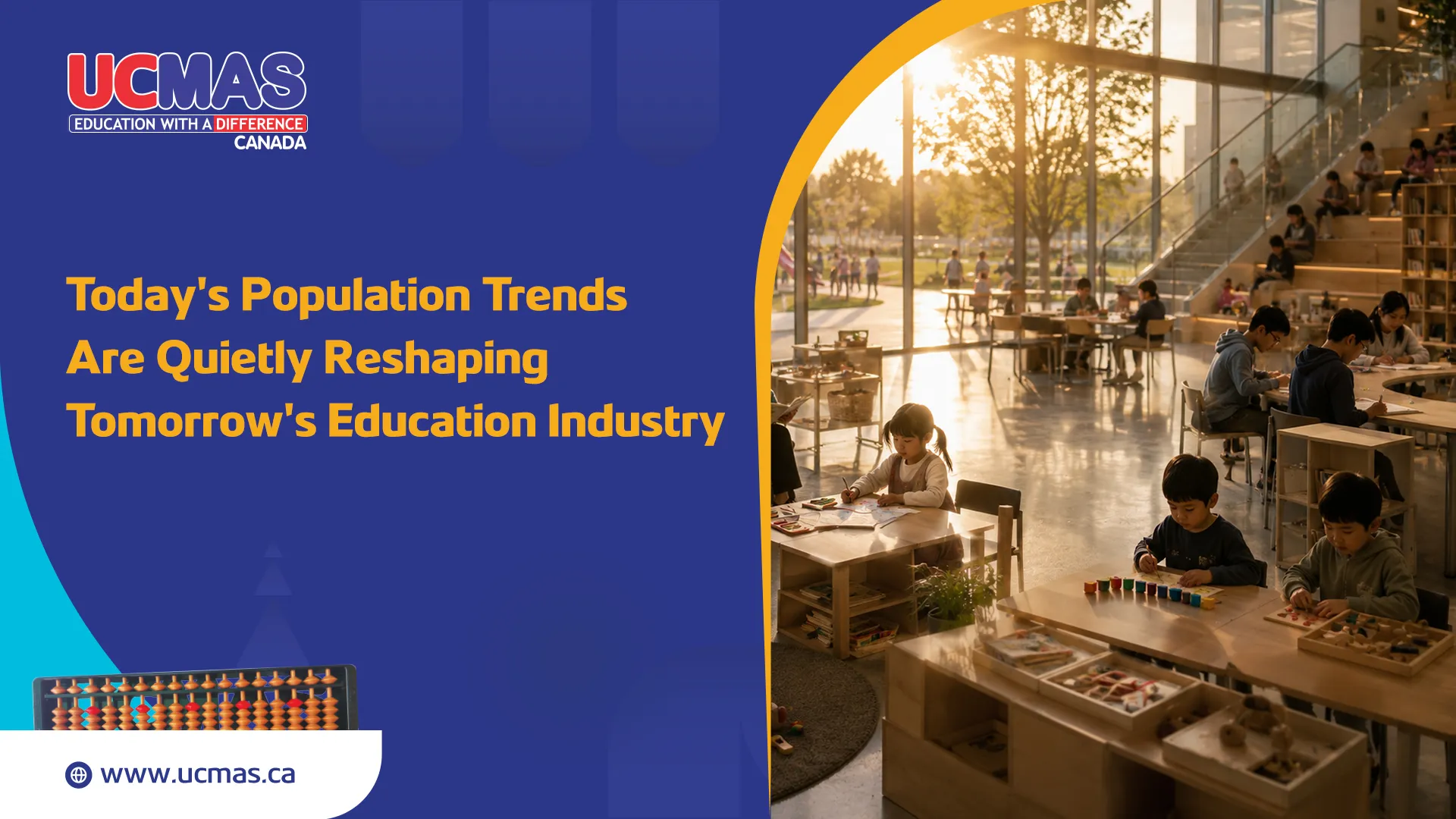
Canada’s education landscape is experiencing a major transformation. Growing immigration, increasing dual-income households, rising academic expectations, and rapid technological advancement are reshaping how parents approach their children’s learning.
Across the country, more families now view supplemental education as an essential investment rather than an optional expense. Whether children need stronger math skills, better concentration, or future-ready cognitive abilities, parents are increasingly turning to structured learning programs outside traditional classrooms.
This shift is creating tremendous opportunities for education providers and families alike. As Canada’s trusted leader in abacus-based brain development, UCMAS continues to help children unlock their full potential through scientifically designed cognitive learning programs.

Canada Is Experiencing a Demographic Shift
Demographics influence nearly every industry, and education is no exception.
Several long-term trends are accelerating demand for supplemental learning:
- Rising immigration bringing thousands of school-age children every year
- Growing multicultural communities prioritizing academic excellence
- Increasing number of working parents seeking productive after-school activities
- Higher awareness of early brain development
- Stronger competition for future careers
Together, these changes are creating sustained demand for educational enrichment programs across Canada.
Unlike temporary market trends, demographic shifts continue for decades, making supplemental education one of the fastest-growing education sectors.
Parents Are Investing Earlier Than Ever
One of the biggest changes over the past decade is the age at which parents begin enrichment learning.
Instead of waiting until academic problems appear, families now invest during preschool and elementary years.
This growing demand has made the early childhood education franchise segment one of Canada’s fastest-growing education categories.
Parents increasingly understand that the early years are ideal for strengthening:
- Memory
- Concentration
- Visualization
- Listening skills
- Numerical confidence
- Learning habits
Rather than focusing only on grades, today’s parents want programs that improve lifelong learning abilities.
Why After-School Learning Has Become Essential
School education provides an important academic foundation, but classroom limitations often prevent individualized learning.
This is where structured enrichment programs add tremendous value.
An effective after school math program gives children opportunities to:
- Build confidence
- Improve calculation speed
- Practice mental visualization
- Develop logical thinking
- Learn without academic pressure
Parents are no longer looking only for homework assistance. They’re looking for programs that strengthen how children think. Read this guide on how investing in children’s learning programs early can be a great move.
Immigration Is Expanding Demand Across Canada
Canada continues welcoming hundreds of thousands of newcomers every year.
Many immigrant families place strong emphasis on academic success because education plays a central role in long-term career opportunities.
These families actively seek programs that help children:
- Adapt quickly
- Build language confidence
- Improve academic performance
- Develop stronger mathematical skills
- Enhance cognitive abilities
This growing population has significantly increased demand for quality supplemental education providers across major provinces.
The Rise of Brain Development Programs
Today’s parents are no longer satisfied with rote memorization.
Instead, they seek programs that strengthen brain development.
An abacus learning center offers a unique combination of mathematics and cognitive skill development.
Children learn to:
- Visualize numbers
- Perform rapid mental calculations
- Strengthen memory
- Improve attention span
- Build confidence
- Increase creativity
These skills extend well beyond mathematics and positively influence classroom performance across multiple subjects.
Parents interested in helping children improve numeracy can also read this guide on how to help your child succeed in math in Canada.
Supplemental Education Is Becoming a Long-Term Industry
Industry experts believe supplemental education will continue expanding through 2030 because demographic drivers remain strong.
Several factors contribute:
Growing Urban Population
Large metropolitan cities continue attracting young families.
Higher population density naturally increases demand for educational programs.
Rising Disposable Income
Parents increasingly allocate household budgets toward children’s development rather than purely recreational spending.
Greater Awareness
Parents today conduct extensive online research before selecting enrichment programs, leading to higher enrollment in evidence-based learning systems.
Why Investors Are Paying Attention
The same demographic forces benefiting families are also attracting entrepreneurs.
Demand for education franchise opportunities continues rising because education remains one of the most resilient industries. For a deeper understanding, explore this guide on the growth of education franchises in Canada.
Unlike many sectors, learning demand continues regardless of economic cycles because parents consistently prioritize their children’s future.
This has contributed to growing interest in education franchise canada models that offer proven systems, established curriculum, and ongoing operational support. Read this guide to learn more about emerging market developments here.
Beyond Traditional Tutoring
Parents increasingly recognize that enrichment is different from remedial education.
Traditional tutoring franchises often focus on improving school grades.
Modern enrichment programs focus on developing the child’s overall thinking abilities.
That distinction matters.
Rather than simply teaching answers, programs like UCMAS strengthen the underlying cognitive skills children use every day.
As a result, many parents now begin enrichment before academic difficulties appear.
The Growing Appeal of Holistic Learning
Today’s parents value programs that build confidence alongside academic performance.
Children benefit from activities that improve:
- Focus
- Discipline
- Confidence
- Decision-making
- Problem-solving
- Independent thinking
These outcomes explain why mental math for kids has become increasingly popular across Canadian families.
Parents appreciate programs that create stronger learners—not just higher test scores.
What Parents Can Do Today
You don’t have to wait until report cards reveal serious concerns.
Start by observing whether your child:
- Avoids math homework
- Counts on fingers for simple calculations
- Gets anxious during tests
- Takes much longer than classmates
- Frequently says, “I’m not good at math.”
Early support is almost always easier than late intervention.
Small improvements today often prevent much bigger challenges later.

Why the Future Looks Bright Through 2030
Several demographic trends suggest continued expansion of supplemental education:
- Continued immigration growth
- Increasing birth rates in several regions
- More dual-income households
- Greater adoption of AI-assisted education
- Rising awareness of brain development
- Increased emphasis on future-ready skills
As technology transforms education, parents will continue seeking programs that balance digital learning with cognitive development.
Organizations that focus on creativity, critical thinking, and lifelong learning are likely to remain in high demand.
Build a Stronger Future with UCMAS
Canada’s demographic transformation is changing how families think about education. Supplemental learning is no longer viewed as extra—it has become an essential part of helping children thrive academically and personally.
For parents, this means investing early in programs that build confidence, concentration, and lifelong learning skills. For aspiring entrepreneurs, it represents one of the most promising sectors in education today.
Whether you’re looking to support your child’s development or explore the future of supplemental education, UCMAS continues to lead with proven programs trusted by families across Canada.
Ready to experience the UCMAS difference? Book a free Abacus session today.