




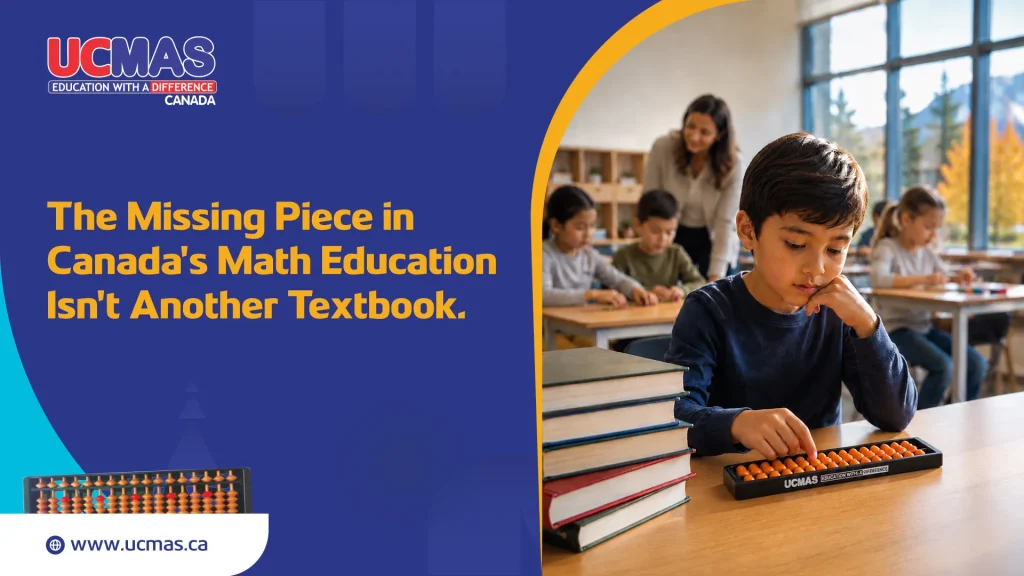
Canadian classrooms are evolving. Today’s students are expected to solve problems, explain their reasoning, identify patterns, and apply mathematics in real-life situations rather than simply memorize formulas.
While schools provide a strong academic foundation, many parents notice that children still struggle with confidence, calculation speed, or staying focused during math lessons. That’s why families across the country are looking beyond traditional classroom learning for additional support.
Programs like UCMAS have become a popular complement to classroom education—not because they replace school, but because they strengthen the cognitive skills children use every day in school.
So, is abacus useful for the Canadian school curriculum?
The answer lies in understanding what schools teach—and what children need to succeed.

Canadian Schools Focus on Understanding. Abacus Strengthens the Brain Behind It.
Across provinces, including the Ontario curriculum, students are encouraged to understand concepts rather than simply memorize answers.
Modern classrooms emphasize:
- Critical thinking
- Number sense
- Mental calculations
- Pattern recognition
- Logical reasoning
- Problem-solving
These expectations go far beyond multiplication tables.
An abacus math course develops many of these same underlying cognitive abilities by training children to visualize numbers, calculate mentally, and process information efficiently.
Instead of teaching school lessons differently, abacus prepares the brain to learn those lessons more effectively.
How Abacus Supports Elementary Math Without Replacing School
Many parents assume that abacus classes simply teach faster calculations.
In reality, they build mental processes that help children across multiple areas of elementary math.
Children gradually learn to:
- Visualize numbers instead of counting mechanically
- Perform calculations mentally
- Improve working memory
- Develop concentration
- Increase confidence while solving unfamiliar questions
These skills naturally transfer into classroom performance.
If you’re wondering how mental math supports younger learners before formal schooling becomes more demanding, read Why Mental Math Before Grade 3 Matters.
Why It Fits Well with the Ontario Curriculum
The Ontario curriculum emphasizes reasoning, communication, and applying mathematics in practical situations.
Rather than relying solely on memorization, students are expected to explain their thinking and solve increasingly complex problems.
An abacus program reinforces these expectations by strengthening:
- Mental visualization
- Number flexibility
- Confidence with calculations
- Logical reasoning
- Independent thinking
Parents looking to better understand provincial learning expectations can also explore Ontario Grade 3 Math Expectations Explained.
More Than Faster Math: Building Problem Solvers
Success in mathematics isn’t just about finding the correct answer quickly.
Children also need:
- Analytical thinking
- Decision-making ability
- Pattern recognition
- Confidence under pressure
These are the same problem solving skills for kids that benefit science, coding, reading comprehension, and even everyday decision-making.
Because abacus develops both speed and accuracy while requiring visualization, it strengthens the brain’s executive functions—not just arithmetic.
School Math Support That Goes Beyond Homework
Parents often search for school math support when report cards begin showing lower scores.
Traditional tutoring usually focuses on reviewing classroom concepts.
Abacus works differently.
Instead of reteaching school lessons, it develops stronger mental processing skills that make classroom learning easier.
This makes it an excellent form of math enrichment rather than remedial instruction.
Children become more confident learners instead of simply better test takers.
For parents looking for broader strategies, How to Help Your Child Succeed in Math in Canada offers additional practical guidance.
Supporting EQAO and Classroom Assessments
Many Ontario parents wonder whether abacus helps with standardized assessments like EQAO.
While abacus is not designed as test preparation, it strengthens the foundational abilities children use during exams:
- Faster calculations
- Better concentration
- Improved accuracy
- Reduced math anxiety
- Greater confidence
These benefits often make it easier for students to complete questions within time limits.
Learn more in How Mental Arithmetic Improves EQAO Math Scores and Why Ontario Students Struggle with EQAO Math Tests.
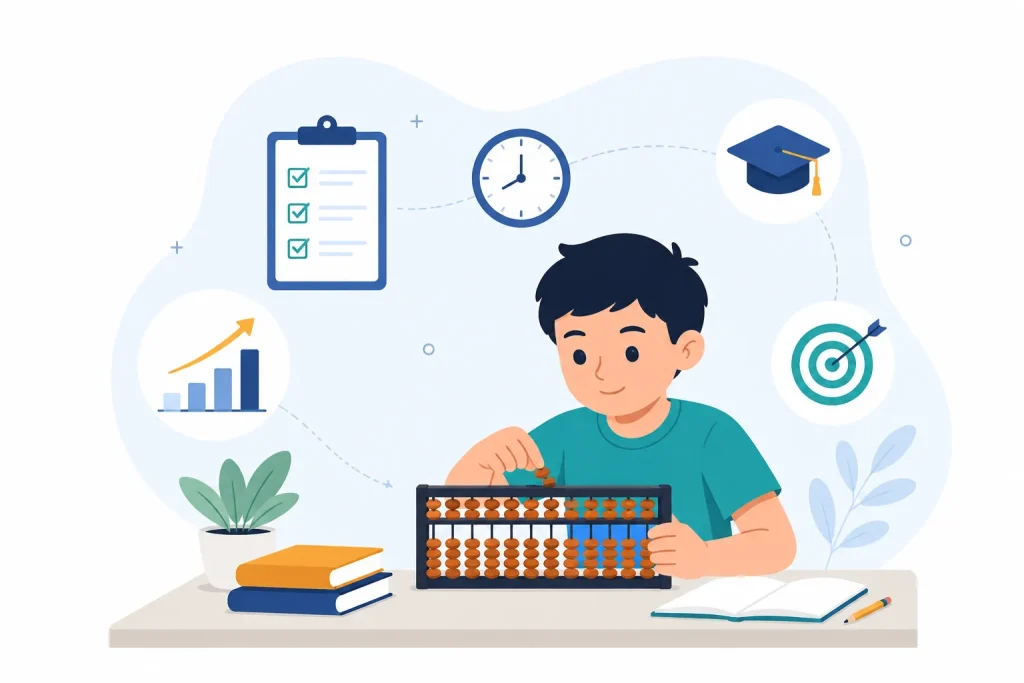
Mental Math Is Becoming a Life Skill
Technology has made calculations easier—but thinking has become more important.
Children who develop strong mental calculation skills often become more confident learners across subjects.
Many families use mental math worksheets at home alongside structured training to reinforce classroom learning, but guided instruction helps children understand strategies instead of simply practicing answers.
Programs offering mental math Canada initiatives emphasize building thinking skills that remain valuable long after school.
To better understand how mental arithmetic supports young learners, read What Is Mental Math for Elementary Students?
Why Parents Across Canada Choose UCMAS
Parents searching for an abacus learning center often want more than better grades.
They want children who:
- Learn independently
- Enjoy mathematics
- Stay focused longer
- Think creatively
- Become confident problem solvers
That is why abacus Canada programs have continued growing in popularity.
Through structured training, visualization exercises, and progressive learning, UCMAS in school initiatives and after-school programs complement classroom education while helping children build lifelong cognitive abilities.
Instead of competing with schools, UCMAS strengthens what schools are already trying to achieve.
Preparing Children for Success Beyond the Classroom
The Canadian school curriculum provides children with excellent academic knowledge. However, lasting success comes from developing the cognitive skills that make learning easier.
Abacus does exactly that.
It strengthens concentration, visualization, logical reasoning, confidence, and mental calculation—all while supporting classroom learning rather than replacing it.
Whether your child is already excelling or simply needs extra confidence, UCMAS offers a proven way to enhance learning through meaningful math enrichment.
Explore more about UCMAS and experience the difference yourself by booking a free assessment session today.