




Math has never been every child’s favourite subject. But today, the concern goes beyond simply hearing, “I don’t like math.”
Across Canada, parents and educators are paying closer attention to declining performance, widening math learning gaps, and children who seem to lose confidence as mathematical concepts become more complex.
The numbers provide some context. In PISA 2022 results, 78% of Canadian 15-year-olds reached at least the baseline Level 2 proficiency in mathematics. While Canada remained above the OECD average, its average mathematics performance was lower in 2022 than in any previous PISA assessment. The proportion of Canadian students below baseline proficiency also increased by seven percentage points between 2012 and 2022.
So, what is behind the problem? And more importantly, what can parents do about it?
At UCMAS, the focus extends beyond helping children calculate answers. By strengthening concentration, visualization, speed, accuracy and confidence, children can develop skills that support the way they approach learning itself.
The Math Problem Did Not Appear Overnight
It would be easy to blame recent declines entirely on pandemic-era disruption, but the story is more complicated.
The OECD notes that the recent decline reinforced a negative trend that had already begun earlier. In other words, Canadian children struggling with math is not simply a post-pandemic issue.
However, school closures and remote learning likely intensified existing challenges for some students. Statistics Canada highlighted concerns around reduced instructional time, access to learning resources and differences in students’ ability to participate effectively in online education.
This means many children may now be dealing with gaps that started small but became more noticeable as math grew harder.
Parents who want a deeper look at the trend can read about why Canadian kids may be falling behind in math.
Small Math Learning Gaps Can Become Bigger Problems
Math is cumulative.
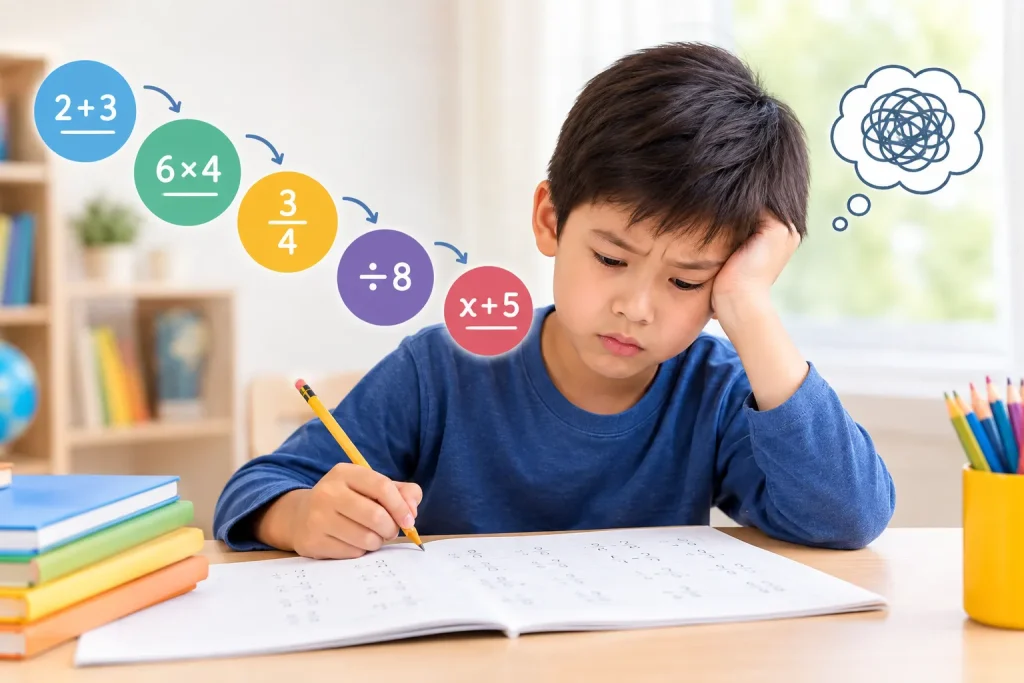
A child who struggles with addition today may find multiplication harder tomorrow. Weak multiplication skills can later make fractions, division, algebra and more advanced problem-solving feel overwhelming.
That is why math learning gaps matter.
Children are constantly building new concepts on previous knowledge. When foundational skills are shaky, they may spend so much mental effort trying to complete basic calculations that understanding the larger problem becomes difficult.
Sometimes, what looks like carelessness or a lack of effort may actually signal deeper math difficulties in children.
Parents can learn more about common math problems children face and how to address them.
Classroom Pace Does Not Work Equally for Every Child
A classroom teacher has to teach many students at once. Inevitably, children absorb concepts at different speeds.
One student may understand fractions after the first explanation. Another may require examples, visualization and repeated practice.
If the class needs to move forward before a child has fully understood the concept, the child can carry that confusion into the next lesson.
Over time, repeated confusion can create frustration. That frustration may turn into avoidance, and avoidance can create even larger learning gaps.
This is one reason parents often begin exploring math tutoring or an after school math program when they notice their child repeatedly struggling with concepts taught at school.
Math Anxiety Can Make the Problem Worse
There is another issue that worksheets alone cannot always solve: confidence.
A child who repeatedly gets answers wrong can begin thinking, “I’m just bad at math.”
Once that belief takes hold, the child may hesitate to answer questions, avoid challenging problems or become anxious about tests and homework. Eventually, math confidence can decline alongside performance.
Interestingly, Canadian PISA findings showed an association between greater confidence and higher average mathematics scores.
This is why effective math support for kids should not focus only on correcting wrong answers. Children also need opportunities to experience progress, solve problems independently and see themselves becoming more capable.
More Practice Is Not Always the Same as Better Practice
When a child struggles, the instinctive response is often to give them more worksheets or hire a math tutor.
Extra practice can certainly help, but only when it addresses the actual problem.
If a child does not understand place value, repeatedly solving harder arithmetic problems may simply reinforce frustration. Effective support should identify the weak foundation first and then build upward.
Parents can explore practical strategies in this guide on how to help your child succeed in math in Canada.
The goal should be meaningful practice rather than simply more practice.
Why Mental Calculation Skills Matter
Children who rely heavily on written steps or calculators for basic arithmetic may find multi-step problems mentally demanding.
Building mental calculation ability can help make numbers more familiar and manageable.
Through mental math for kids, children practise working with numbers without depending entirely on written calculations. Over time, this can help them approach numerical problems with greater speed and comfort.
Mental math courses can also give children regular, structured opportunities to practise calculation while exercising concentration, visualization and memory.
This does not replace school mathematics. Instead, it can strengthen foundational abilities that children can carry back into the classroom.

The Problem Is Visible in Provincial Assessments Too
The concern around math performance is not limited to international assessments.
Parents in Ontario, for example, may have seen ongoing discussions around provincial math performance and EQAO assessments. Understanding why Ontario students struggle with EQAO math tests can help families recognize that test performance may reflect several factors, including foundational understanding, problem-solving ability and confidence.
Rather than waiting for a poor report card or test result, parents can watch how their child approaches math day to day.
Does homework regularly end in frustration? Does the child avoid mental calculations? Are basic concepts taking unusually long? Do they immediately say “I can’t do it” when they see an unfamiliar problem?
These signs can indicate that additional support may be useful.
Helping Children Catch Up Without Making Math Feel Like Punishment
When children fall behind, piling on more pressure can make math feel even more intimidating.
Instead, support should help children experience small, achievable wins.
Start with concepts they can manage and gradually increase the challenge. Encourage them to explain how they reached an answer instead of focusing only on whether the answer is correct. Celebrate improvement in speed, accuracy, concentration and persistence.
Structured math tutoring can be valuable when a child needs targeted help with curriculum concepts. At the same time, skill-building approaches such as mental math courses can complement classroom learning by helping children become more comfortable working with numbers.
The objective is not simply to catch up for the next test. It is to help children develop the ability and confidence to keep learning as math becomes more challenging.
Stronger Math Skills Begin With Stronger Foundations
Canada continues to perform above the OECD average in mathematics, so the picture is not one of universal failure. Yet the downward trend deserves attention. In PISA 2022, approximately 22% of Canadian students did not reach baseline mathematics proficiency.
For parents, the takeaway is not to panic. It is to pay attention early.
When children receive the right support before small difficulties become entrenched, math can become less intimidating and more manageable.
Programs such as UCMAS aim to strengthen more than calculation ability. Through structured abacus and mental math practice, children work on concentration, visualization, speed, accuracy and confidence that can support their broader learning journey.
Book an abacus session with UCMAS and discover how structured mental math training can help build stronger foundations.