



A new school year usually means new notebooks, sharpened pencils, organized schedules, and perhaps a little back to school math revision. But while parents spend time preparing backpacks and refreshing academic concepts, there is another kind of preparation that can make a meaningful difference: preparing the brain to adapt.
Children return to classrooms where they may encounter new teachers, unfamiliar routines, harder subjects, different expectations, and increasingly complex problems. Being able to shift from one task or strategy to another can therefore be just as valuable as remembering what they learned last year.
At UCMAS, children develop skills that extend beyond calculation. Through structured abacus and mental math practice, they exercise concentration, memory, visualization, problem-solving, and flexible thinking, abilities that can support them as the new school year unfolds.
The Back-to-School Skill Parents May Be Overlooking
Most back to school preparation focuses on what children know. Can they remember multiplication tables? Are their reading skills on track? Have they revised last year’s concepts?
But school also constantly tests how children respond when things change.
A child may understand one method of solving a problem and then be asked to approach it differently. They might have to stop working on math and quickly shift their attention to reading. They may need to follow a new classroom routine or correct an approach after noticing a mistake.
This is where cognitive flexibility in children becomes important.
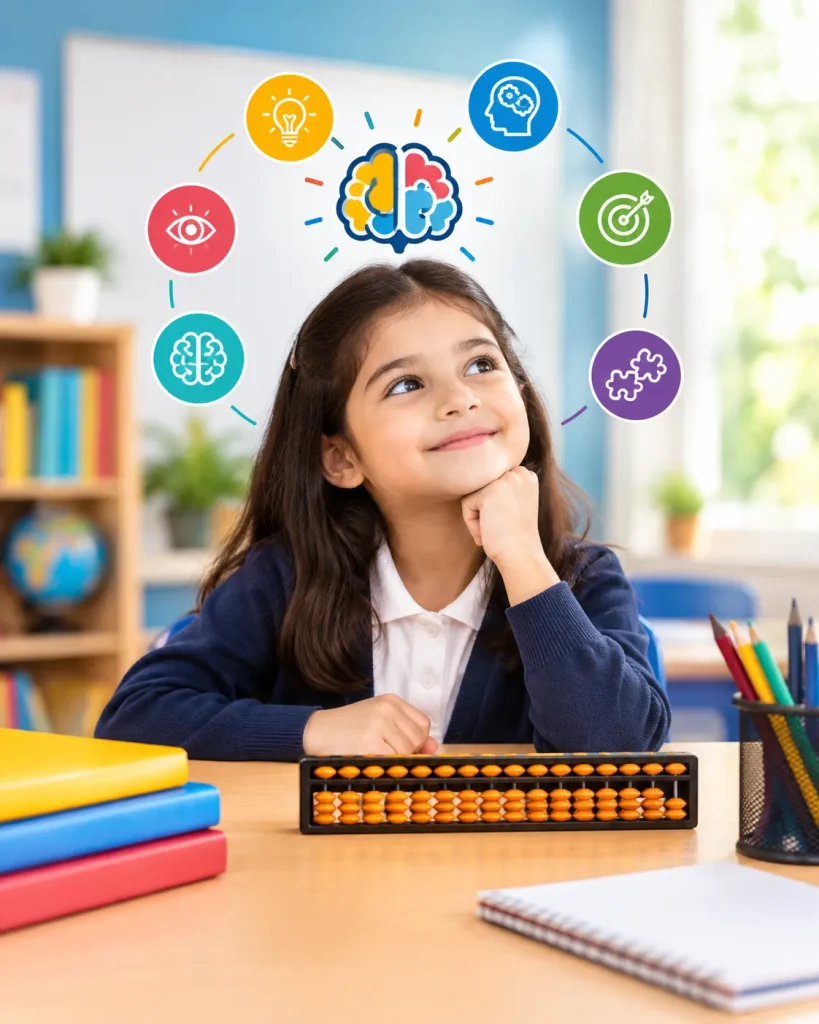
Cognitive flexibility is an executive-function skill that helps a person adjust their thinking or behaviour when circumstances, rules, or demands change. Instead of remaining stuck on one approach, a flexible thinker can consider another route.
For parents thinking beyond grades, the UCMAS guide to 2026 Skills for Kids – Top Cognitive Abilities for School and Beyond offers a useful perspective on the abilities children may increasingly need.
Why Cognitive Flexibility Matters When School Starts Again
Think about an ordinary school day from a child’s perspective. Within a few hours, they might listen to instructions, calculate an answer, participate in a discussion, work independently, collaborate with classmates, and move between completely different subjects.
That requires more than knowledge. It requires mental switching.
Stronger cognitive flexibility may help children:
- adjust to new classroom expectations
- try a different strategy when the first one does not work
- move between subjects and types of tasks
- respond to feedback and corrections
- approach unfamiliar problems with greater willingness to experiment
- manage changes in routines more effectively
This is why school readiness should not be viewed only as knowing the right answers. It also includes developing the mental habits that help children work towards those answers when the path is unfamiliar.
How Abacus Training Exercises a Flexible Brain
At first glance, abacus learning might appear to be primarily about arithmetic. However, the learning process asks children to engage several mental abilities.
Beginners physically manipulate beads while learning number relationships and calculation methods. With continued practice, children progress toward visualizing the abacus mentally and performing calculations without relying on the physical tool.
This progression asks the brain to move between seeing, touching, remembering, visualizing, and calculating. Children are not simply memorizing answers. They repeatedly process information and apply learned strategies.
The connection between abacus practice and attention-related abilities is explored further in this guide in How Abacus Helps Improve Focus & Memory in Kids.
For families exploring brain training for kids, this structured practice can complement regular academics by giving children opportunities to exercise multiple cognitive processes within the same activity.
Mental Math Teaches Children to Think Beyond One Route
Traditional worksheets can sometimes encourage children to associate mathematics with following a fixed sequence of steps. Mental math for children can add another dimension by encouraging them to work with numbers mentally and recognize relationships more quickly.
Imagine a child facing a calculation that initially looks difficult. Rather than immediately feeling blocked, practice can encourage them to break the problem down, visualize quantities, recall patterns, and apply an appropriate strategy.
That mindset matters beyond arithmetic.
When children become accustomed to processing problems actively, they practise an important learning behaviour: “If this approach isn’t working, what else can I try?”
Parents interested in developing these abilities can explore the UCMAS Mental Math Program for Children to understand how structured abacus-based learning progresses from physical calculation toward mental visualization.
Back-to-School Math Activities Can Prepare More Than Math Skills
Back to school math activities do not have to mean giving children pages of calculations before September. A more engaging approach can combine arithmetic with attention, memory, and flexible thinking.
Parents can try short mental calculation challenges, number-pattern games, puzzles, estimation exercises, memory games, or asking children to explain two different ways of reaching an answer. Even everyday situations, such as calculating change or estimating a grocery total, can turn numbers into active thinking exercises.
The goal is not to make the final weeks of summer feel like extra school. It is to gradually reintroduce focused thinking and problem-solving before classroom routines become demanding again.
From Cognitive Flexibility to Everyday Confidence
There is another reason flexible thinking matters: children rarely experience school as a purely academic environment.
They have to communicate, cooperate, listen, manage time, respond to mistakes, and navigate social situations. These abilities can influence how comfortably they handle a new school year.
The UCMAS approach is designed to develop children beyond calculation alone. Read How UCMAS Builds Soft Skills in Kids to see how structured learning can also encourage abilities that children use in everyday situations.
The objective is not simply to make a child faster at arithmetic. It is to help develop a learner who is more prepared to concentrate, process information, attempt challenges, and keep working when the answer is not immediately obvious.

Brain Prep Should Fit Into a Child’s Life, Not Take It Over
Parents understandably want children to begin the school year strongly, but filling every free hour with academic work can be counterproductive.
Children still need rest, play, physical activity, family time, and opportunities to pursue interests. The key is consistency rather than overload.
Short periods of focused cognitive practice can be incorporated into a balanced routine. Parents wondering how to make enrichment work alongside academics can read How to Balance School & Extracurricular Activities.
Effective preparation should help a child feel ready for September, not exhausted before school even begins.
Prepare the Brain, Not Just the Backpack
Back-to-school shopping prepares children with the things they will carry into the classroom. Cognitive preparation can strengthen the skills they bring to every lesson.
As academic challenges change, children benefit from being able to focus, remember, visualize, calculate, reconsider, and adapt. Developing cognitive flexibility in children can therefore be an important part of preparing them for a school year filled with new expectations.
Through abacus practice and mental calculation, UCMAS gives children structured opportunities to exercise these abilities while building a stronger relationship with numbers and learning.
A new backpack lasts a year. Stronger thinking skills can support learning far beyond September.
Book a UCMAS Abacus Session for Your Child and discover how abacus and mental math training can become part of your child’s back-to-school brain preparation.