



A child brings home a report card filled with A’s. They remember formulas, complete assignments on time, and perform well in exams. Naturally, parents feel proud. But there is another question worth asking: Are good grades enough to prepare a child for life?
Academic achievement matters, but life rarely presents problems in the form of a textbook question with one correct answer. Children will eventually need to make decisions, communicate ideas, recover from setbacks, solve unfamiliar problems, and stay focused when things become difficult.
This is why programs such as UCMAS look beyond calculation ability alone. By engaging children in structured mental math and cognitive training, the goal is to strengthen abilities that can support them both inside and outside the classroom.
The Definition of “First” Is Changing
For generations, being “first” often meant scoring the highest marks or standing at the top of the class. But the world children are growing into demands a much broader set of abilities.
Technology can retrieve information instantly. AI can answer questions, summarize ideas, and perform calculations. What becomes increasingly valuable is how children use information: Can they question it? Can they connect ideas? Can they solve a problem when the answer is not obvious?
As explored in this article on why real intelligence matters in the age of AI, developing human abilities such as reasoning, adaptability, and independent thought becomes particularly important when technology can handle many routine tasks.
Being first in life, therefore, is not necessarily about outperforming everyone else. It is about being prepared to think, adapt, learn, and keep moving forward.
What Do Children Need Beyond Academics?
The skills children need beyond academics are not separate from learning. In fact, they often determine how effectively children use what they have learned.
Consider a child who knows a mathematical formula but freezes when the problem is presented differently. Another child may not immediately know the answer but can analyze the situation, try different approaches, and eventually work it out.
The second child is demonstrating valuable cognitive skills.
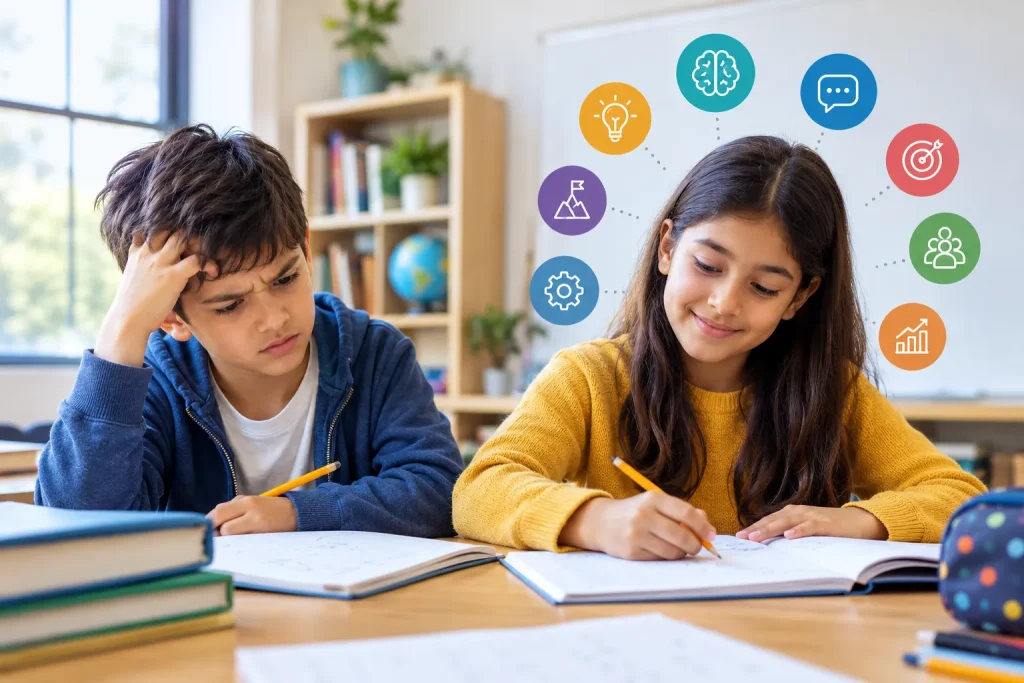
Some of the most important abilities include concentration, adaptability, independent thinking, communication skills, decision-making, confidence, and perseverance. These are among the broader cognitive abilities children need for the future.
Strong academics can open doors. These abilities can help children know what to do once those doors open.
Problem-Solving: Learning What to Do When You Don’t Know What to Do
Many school exercises are designed around instructions: follow the method, apply the formula, find the answer.
Real life is rarely that predictable.
Children may have to decide how to manage competing priorities, resolve disagreements, understand why something went wrong, or approach a challenge they have never seen before. This is where problem solving skills for kids become valuable.
Mental math practice can provide children with repeated opportunities to process information, identify patterns, visualize solutions, and work towards answers without depending immediately on external tools.
Over time, children learn an important lesson: not knowing the answer immediately does not mean they cannot find it.
That mindset can matter far beyond mathematics.
Confidence Is Built Through Doing Difficult Things
Confidence building for kids does not have to revolve around constant praise or telling children they are naturally talented.
Meaningful confidence can grow when a child struggles with something, keeps trying, improves, and realizes, “I can handle this.”
A difficult calculation, a mistake during practice, or a challenging activity can become a small opportunity to develop persistence. UCMAS explores this further in its article on how children learn from setbacks.
Children who experience manageable challenges can gradually become more comfortable with mistakes. Instead of treating difficulty as proof that they are “bad” at something, they can begin seeing it as part of learning.
That shift can influence how they approach school, sports, friendships, hobbies, and eventually professional challenges.
Focus May Become One of Their Biggest Advantages
Children today are surrounded by notifications, videos, games, devices, and constant streams of information. In such an environment, being able to concentrate deliberately can become a powerful advantage.
This is one reason parents may explore structured activities or focus classes for children that require sustained attention rather than passive consumption.
During abacus and mental math exercises, children need to listen carefully, visualize numbers, process information, and calculate accurately. These activities continually bring attention back to the task at hand.
Focus is not useful only for getting better marks. It helps children listen, complete tasks, follow conversations, learn new skills, and work towards longer-term goals.
Critical Thinking Helps Children Ask Better Questions
Knowing facts is useful. Knowing what to do with those facts is even more important.
Critical thinking for kids involves learning to examine information, identify connections, compare possibilities, and reach conclusions instead of automatically accepting the first answer.
Parents can encourage this ability through simple questions:
“What else could you try?”
“Why do you think that happened?”
“Is there another way to solve it?”
These conversations encourage children to think rather than simply recall. When combined with activities that require active reasoning and problem-solving, they can help children become more independent learners.
Soft Skills Are Not Really “Soft”
Imagine two academically strong students entering adulthood.
Both have knowledge. But one communicates clearly, remains composed under pressure, adapts quickly, listens to others, and approaches unfamiliar problems confidently. The other struggles whenever there are no instructions to follow.
Their grades may once have looked similar, but their ability to navigate real situations can be very different.
That is why life skills for children deserve attention alongside academics. As explained in this resource on how UCMAS helps build soft skills in children, abilities such as confidence, focus, discipline, and perseverance can influence how children approach challenges and learning.
These abilities are not alternatives to academic achievement. They help children make better use of it.
The Goal Is Not to Raise a Child Who Never Struggles
Parents naturally want to make life easier for their children. But removing every difficulty can also remove opportunities to practise overcoming difficulties.
Children need age-appropriate opportunities to struggle, think, make mistakes, adjust, and try again.
A child who learns that every challenge has to be solved by a parent, teacher, calculator, or search engine may hesitate when independent thinking is required. A child who regularly exercises their own thinking learns something different: I can attempt this myself.
This is one of the reasons cognitive training can complement traditional academics. It does not simply ask, “How much does the child know?” It also strengthens the mental processes they use while learning.
From First in Class to First in Life
There is nothing wrong with wanting children to do well academically. Good grades can reflect discipline, knowledge, and effort.
But a report card captures only part of a child’s potential.
The future will also reward children who can think independently, communicate confidently, stay focused, solve unfamiliar problems, and recover when their first attempt does not work.
At UCMAS, mental math and abacus training are designed to exercise the mind while children learn. Because ultimately, success is not only about knowing the right answer. It is also about developing the ability and confidence to find one when life does not provide instructions.
Book a UCMAS abacus session and discover how mental training can help your child grow beyond academics.