



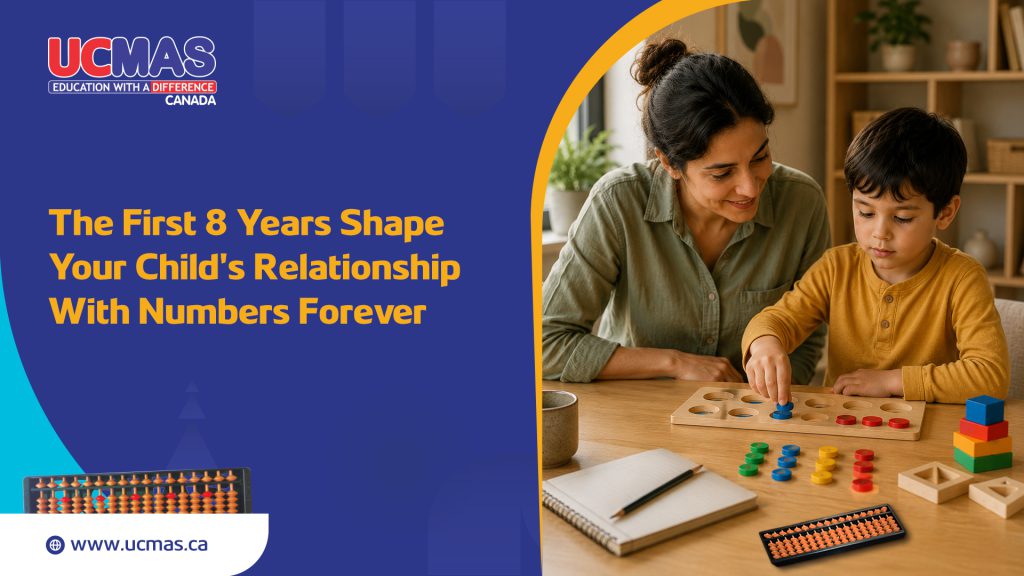
Parents often assume that serious math learning begins when children start multiplication, division, and more advanced concepts in elementary school.
In reality, the foundation for future mathematical success is built much earlier.
Research consistently shows that the early elementary years play a crucial role in developing number sense, problem-solving abilities, concentration, and confidence with numbers. By the time a child reaches Grade 3, many of the cognitive habits that influence future math performance are already taking shape.

At UCMAS, children begin strengthening these essential skills long before complex classroom mathematics arrives. Early training helps students develop speed, accuracy, focus, and confidence that support learning across all academic subjects.
The question is not whether children should learn mental math.
The real question is whether they should start before Grade 3.
Why Grade 3 Is Often Called the “Turning Point” in Mathematics
Educators frequently describe Grade 3 as a transition year.
Before Grade 3, children primarily learn basic arithmetic concepts such as:
- Counting
- Number recognition
- Addition
- Subtraction
- Basic patterns
- Place value
After Grade 3, mathematics becomes increasingly abstract.
Students are expected to:
- Understand multiplication and division
- Solve multi-step word problems
- Work with fractions
- Apply mathematical reasoning
- Analyze relationships between numbers
Children who lack strong foundational number sense often struggle when these concepts become more complex.
The challenge is rarely intelligence.
More often, it is the result of an underdeveloped mathematical foundation.
The Brain Develops Rapidly During Early Childhood
Neuroscience shows that children’s brains experience significant development during the early elementary years.
Neural pathways responsible for memory, concentration, visualization, and problem-solving become stronger through consistent practice and stimulation.
This is one reason why structured learning programs during childhood often produce long-term academic benefits.
When children engage in activities that require mental calculation, pattern recognition, and visualization, they strengthen cognitive skills that extend beyond mathematics.
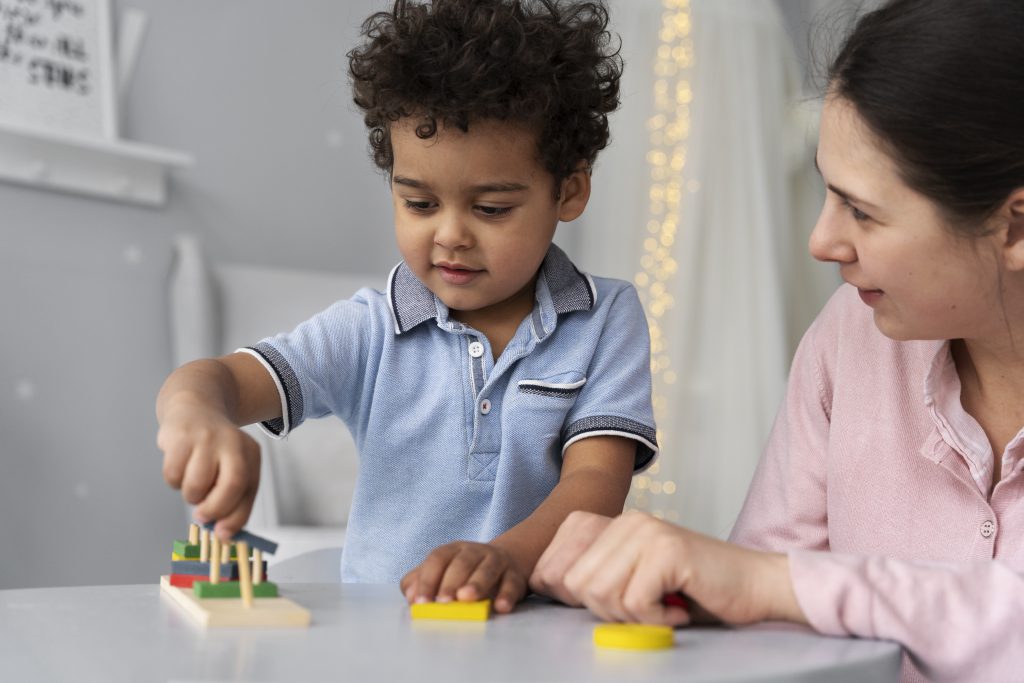
These skills support:
- Better concentration
- Faster information processing
- Stronger working memory
- Improved analytical thinking
- Greater confidence when learning new concepts
The earlier these abilities are developed, the stronger they become over time.
Number Sense Is More Important Than Memorization
Many traditional math approaches emphasize memorizing formulas and procedures.
However, successful mathematicians rely heavily on number sense.
Number sense refers to a child’s ability to understand numbers intuitively, recognize relationships between them, and manipulate them mentally.
For example, a child with strong number sense can quickly recognize that:
- 49 + 51 = 100
- 25 × 4 = 100
- 98 is close to 100
without relying entirely on written calculations.
Developing strong mental math for kids helps create this intuitive understanding of numbers.
Children who understand numbers deeply often solve problems more efficiently and approach mathematics with greater confidence.
Why Early Mental Math Training Creates Long-Term Advantages
Many parents focus on helping children improve current grades.
While academic performance is important, the long-term benefits of mental math training are often even more valuable.
A structured mental math program helps children develop skills that remain useful throughout their education.
These include:
- Faster Calculation Speed: Children learn to process numbers quickly and accurately without depending heavily on calculators.
- Improved Focus: Mental calculations require sustained attention, helping children strengthen concentration skills.
- Enhanced Memory: Visualization techniques encourage stronger working memory and information retention.
- Better Problem-Solving: Students become more comfortable analyzing problems and identifying solutions independently.
- Increased Confidence: Success with numbers often improves overall academic confidence.
These benefits extend far beyond mathematics classrooms.
How Abacus Training Supports Brain Development
One reason UCMAS has become popular worldwide is its unique learning approach.
Through structured abacus math training, children first learn calculations using a physical abacus and later visualize the abacus mentally to solve increasingly complex problems.
This process activates multiple areas of the brain simultaneously.
Students use:
- Visual processing
- Auditory learning
- Logical reasoning
- Memory recall
- Motor coordination
As training progresses, calculations become increasingly mental rather than physical.
The result is a comprehensive cognitive workout that supports overall brain development.
Parents interested in understanding how skills progress through each stage can explore the UCMAS program structure to see how students advance from foundational concepts to advanced mental calculation.
The Cost of Waiting Too Long
Many parents wait until a child begins struggling with mathematics before seeking support.
Unfortunately, by that point, children may already have developed:
- Math anxiety
- Low confidence
- Negative attitudes toward numbers
- Avoidance behaviors
These challenges can become difficult to reverse.
Early intervention is often far more effective than remediation later.
When children begin building strong mathematical foundations before academic difficulties emerge, they are more likely to view math as manageable and enjoyable.
Instead of catching up, they continue moving forward with confidence.
Mental Math Builds Skills Beyond Mathematics
One common misconception is that mental math training only improves calculation abilities.
In reality, the benefits extend across multiple areas of learning.
Students frequently experience improvements in:
- Reading Comprehension: Stronger concentration supports better reading performance.
- Classroom Participation: Confident learners are often more willing to engage and ask questions.
- Time Management: Improved focus helps children complete tasks more efficiently.
- Academic Independence: Students become more comfortable solving problems without constant assistance.
These broader benefits explain why many parents seek enrichment opportunities beyond regular classroom instruction.
Programs such as the UCMAS after-school program provide structured opportunities for children to continue developing these essential skills outside regular school hours.
What Parents Can Do at Home
Parents play an important role in supporting early mathematical development.
Simple activities can help reinforce number sense and mental calculation skills.
Examples include:
- Counting objects during daily routines
- Estimating totals while shopping
- Playing number-based games
- Practicing quick calculations
- Using age-appropriate mental math worksheets
While these activities are valuable, structured programs often provide the consistency and progression necessary for long-term skill development.
A professionally designed mental arithmetic course ensures that concepts build upon one another systematically while keeping children engaged and motivated.
Similarly, well-designed mental math courses provide regular practice that helps children strengthen both mathematical and cognitive abilities over time.
The Earlier the Foundation, the Stronger the Future
The goal of early mental math development is not simply to create faster calculators.
It is to help children become confident thinkers.
Children who develop strong number sense before Grade 3 are often better prepared to handle increasingly complex academic challenges. They approach mathematics with confidence, solve problems more efficiently, and build cognitive skills that support learning throughout their lives.
At UCMAS Canada, students begin developing these essential skills through structured abacus and mental math training designed specifically for young learners. The earlier children build these foundations, the greater the long-term benefits they can enjoy both inside and outside the classroom.
Book a FREE UCMAS abacus session today and discover how early mental math training can help your child build a stronger academic future.