



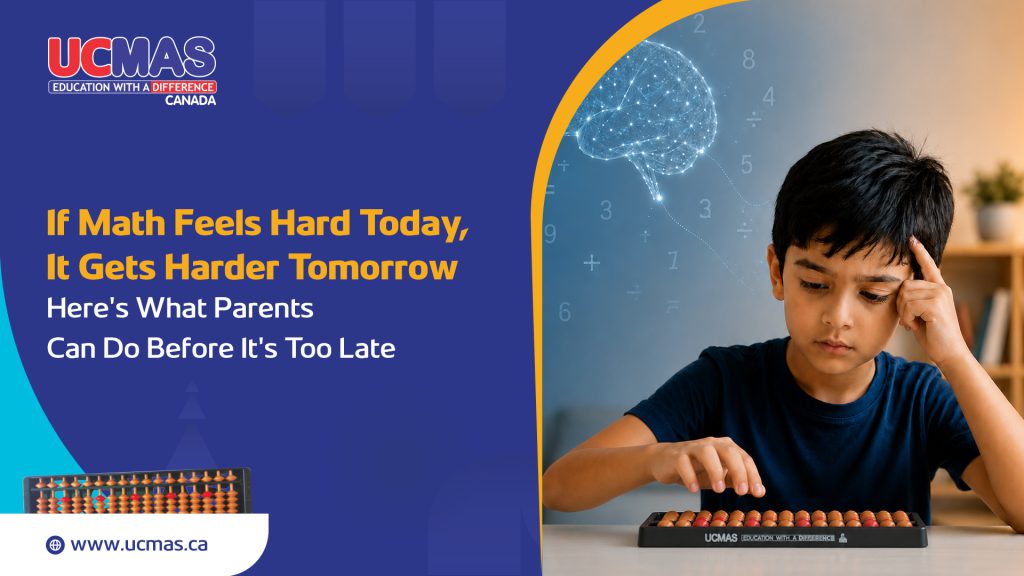
Parents across Canada are asking an important question: Why does math seem harder for children today than it did a generation ago?
While technology has transformed education and students have access to more learning resources than ever before, concerns about declining math performance continue to grow. Teachers, education experts, and parents are noticing that many children struggle with basic calculations, problem-solving, and confidence in mathematics.
At UCMAS, we work with thousands of families who want to strengthen their children’s learning abilities before small academic gaps become larger challenges. Understanding what’s happening in math education is the first step toward helping children succeed.
The Growing Concern Around Math Performance
Math skills form the foundation for success in science, technology, engineering, finance, and many everyday life situations. Yet many educators report that students are finding it increasingly difficult to perform calculations without relying on calculators or digital devices.
Parents often notice signs such as:
- Difficulty recalling basic math facts
- Slow calculation speed
- Lack of confidence during homework
- Avoidance of math-related tasks
- Anxiety during tests and assessments
These challenges do not necessarily mean a child lacks ability. In many cases, they indicate that foundational skills have not been fully developed.

This is why many families are exploring alternatives such as structured math after school programs that focus on strengthening core learning skills beyond regular classroom instruction.
Why Are Children Struggling More With Math?
Several factors contribute to the growing math challenge.
Increased Dependence on Technology
Technology offers many educational benefits, but it has also reduced the need for mental calculation. Children often reach for calculators or apps before attempting problems independently.
As a result, they may miss opportunities to strengthen number sense, memory, and problem-solving abilities.
Learning Gaps Created During Early Education
Even small gaps in understanding can become significant over time.
A child who struggles with addition may later struggle with multiplication. Weak multiplication skills can make fractions and algebra more difficult.
Math learning is cumulative. Missing one step often affects future learning.
Reduced Confidence
Many children begin believing they are “not good at math” after only a few difficult experiences.
This mindset can become a bigger obstacle than the math itself.
When confidence decreases, effort often decreases as well, creating a cycle that becomes increasingly difficult to break.
The Hidden Impact of Weak Math Skills
When parents think about math challenges, they often focus on grades.
However, weak math skills affect much more than report cards.
Children may experience:
- Lower academic confidence
- Difficulty concentrating
- Reduced problem-solving abilities
- Increased test anxiety
- Hesitation when approaching new challenges
Research has shown that strong numerical thinking supports broader cognitive development, including memory, attention, and reasoning.
This is one reason why many educators are placing greater emphasis on programs that develop thinking skills rather than simply teaching school curriculum.
Parents interested in understanding these connections can explore this article on how abacus training shapes child brain development.
Why Traditional Homework Support Isn’t Always Enough
When children struggle, many parents immediately search for a private math tutor.
While tutoring can help address specific school assignments, it often focuses primarily on current classroom content.
A typical math tutor may help students solve today’s homework problems, but may not address underlying challenges such as:
- Poor concentration
- Weak memory
- Limited visualization skills
- Slow calculation speed
- Lack of confidence
To create lasting improvement, children often need support that strengthens the cognitive skills behind mathematical thinking.
The Role of Mental Math in Academic Success
One of the most effective ways to strengthen mathematical confidence is through structured mental math programs.
Unlike traditional approaches that rely heavily on memorization, mental math for kids focuses on developing the brain’s ability to process information efficiently.
Children learn to:
- Visualize numbers
- Calculate faster
- Improve concentration
- Strengthen memory
- Solve problems independently

These skills often extend beyond mathematics and support overall academic performance.
How Abacus Training Builds Stronger Thinkers
Abacus learning has been used globally for decades because it engages multiple areas of the brain simultaneously.
As children progress through training, they learn to visualize the abacus mentally, allowing them to perform calculations without physical tools.
This process develops:
- Concentration
- Memory retention
- Observation skills
- Listening ability
- Analytical thinking
- Self-confidence
Parents who want to learn more about the science behind this approach can read how abacus training supports brain development in children.
Why More Parents Are Choosing After-School Learning Programs
Parents today are looking beyond short-term academic fixes.
They want learning experiences that help children become stronger thinkers, better learners, and more confident individuals.
An effective after school math program should not simply teach math concepts. It should help children develop the mental skills needed to approach challenges independently.
Programs that focus on concentration, memory, and reasoning often produce benefits that extend across multiple school subjects.
This is why many Canadian families are choosing enrichment programs that support both academic and cognitive development.
What Parents Can Do Right Now
If you are concerned about your child’s math progress, there are several practical steps you can take:
Encourage Mental Calculation
Ask children to solve simple calculations mentally before using calculators.
Make Math Part of Daily Life
Use shopping, cooking, budgeting, and travel planning as opportunities to practice numbers.
Focus on Confidence
Praise effort, persistence, and improvement rather than only correct answers.
Look Beyond School Grades
A child may earn acceptable grades while still struggling with confidence or foundational skills.
Explore Brain Development Programs
Programs that strengthen concentration, memory, and thinking abilities can provide benefits far beyond mathematics.
Parents can also explore additional educational resources and expert insights through the UCMAS Reading Corner.
Building Strong Math Foundations for the Future
The goal is not simply to help children pass the next test.
The real objective is to develop confident learners who can think critically, solve problems independently, and approach challenges with confidence.
As the world becomes increasingly data-driven and technology-focused, strong mathematical thinking will remain one of the most valuable skills a child can possess.
Parents who take action early often find that improving concentration, confidence, and cognitive skills creates positive results throughout a child’s educational journey.
Helping Canadian Children Rediscover Confidence in Math
Math struggles do not define a child’s potential. In many cases, they simply indicate that the right support system has not yet been introduced.
At UCMAS Canada, our focus goes beyond calculations. We help children strengthen concentration, memory, visualization, and problem-solving skills that support lifelong learning success.
When children learn how to think more effectively, they often discover that math becomes less intimidating and far more enjoyable.
Give your child the opportunity to develop confidence, concentration, and lifelong learning abilities through UCMAS.
Book a free UCMAS session today.