



Ask a child what they want to be when they grow up, and you may hear familiar answers: doctor, engineer, teacher, scientist, or entrepreneur. But what if some of the most exciting careers of their adulthood have not even been invented yet?
Technology, artificial intelligence, automation, and new industries are changing how people work. For parents, this creates an unusual challenge: How do you prepare a child for a future you cannot accurately predict?
The answer may be to focus less on predicting specific careers and more on developing abilities that remain useful when careers change. Skills such as concentration, adaptability, creativity, problem-solving, numerical confidence, and independent thinking can give children a stronger foundation for whatever comes next.
That is why programs such as the UCMAS child development and mental math program focus not simply on faster calculation, but on developing learning abilities such as concentration, visualization, memory, and confidence through structured abacus and mental math practice.
The Career Map Is Being Redrawn
Think about how many familiar careers today would have sounded unusual a generation ago: app developer, social media strategist, drone operator, cybersecurity analyst, AI engineer, or digital content creator.
A child entering elementary school today could eventually work in an industry that is only beginning to emerge—or one that has not been imagined at all.
This changes the purpose of preparation.
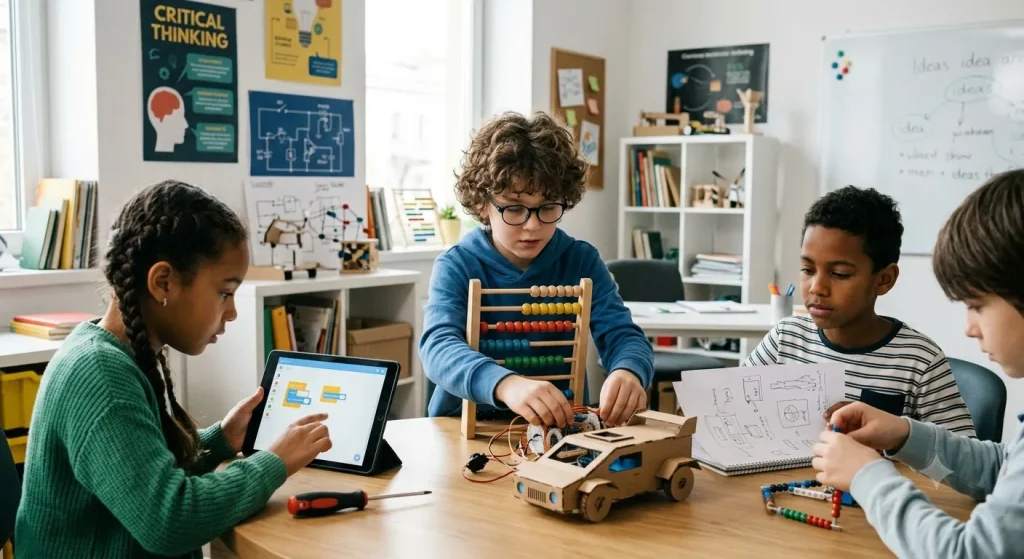
Knowing facts will remain important, but children will also need to know what to do when they do not know the answer. Can they examine a problem? Stay focused when it becomes difficult? Test another approach? Learn a new tool? Recognize patterns? Trust themselves enough to try?
Preparing children for the future therefore means strengthening the mind behind the knowledge.
Future-Ready Children Need Adaptability, Not Just Answers
A child can learn how to use today’s technology, but that technology may be outdated before they enter the workforce.
Adaptability is different. It gives children the ability to learn, unlearn, adjust, and respond to unfamiliar situations.
This can begin with surprisingly simple experiences. When children encounter a challenging calculation, puzzle, activity, or classroom problem, they have an opportunity to practise persistence. Instead of immediately receiving the solution, they can learn to think:
What do I know? What can I try? Is there another way to solve this?
That thinking process matters.
Activities such as mental math for kids can help children practise working through increasingly challenging calculations while developing concentration, observation, visualization, and memory. UCMAS describes rapid calculation as an outcome of developing these broader mental abilities rather than the program’s only purpose.
Confidence Could Become One of the Most Valuable Career Skills
Imagine two children facing a problem they have never encountered.
One thinks, I don’t know how to do this.
The other thinks, I don’t know how to do this yet, but I can figure it out.
That small difference can become powerful over time.
Effective confidence building for kids should not mean constantly telling children they are brilliant. Sustainable confidence grows when children experience progress through their own effort.
When a difficult calculation gradually becomes manageable, children receive evidence that practice works. When they solve something independently, they begin trusting their abilities.
That form of confidence building for kids can matter far beyond mathematics. In a future filled with unfamiliar technologies and changing expectations, children who are willing to attempt difficult things may be better positioned to keep learning.
Focus May Become a Superpower in a Distracted World
Technology can make information easier to access, but access to information is not the same as being able to concentrate on it.
Children still need to read carefully, listen, observe, remember instructions, recognize patterns, and complete tasks without constantly switching their attention.
This is why parents considering focus classes for children should look beyond whether an activity simply keeps a child occupied. The stronger question is whether the activity requires sustained mental engagement.
UCMAS exercises, for example, involve repeated practice and mental calculation. The program emphasizes sustained focus, time management, concentration, visualization, and working through a long series of sums.
Whether tomorrow’s workplace involves artificial intelligence, biotechnology, robotics, virtual environments, or industries yet to emerge, the ability to direct one’s attention deliberately is likely to remain useful.
Why Mental Math Matters in a Technology-Driven Future
If calculators and AI can perform calculations instantly, why should children learn mental math?
Because the objective is not to compete with a machine at arithmetic.
It is to exercise the child’s own thinking.
Structured abacus mental math requires children to engage with numbers, recognize relationships, visualize the abacus, recall information, and arrive at solutions mentally. UCMAS explains that children progress from using a physical abacus toward forming a mental image of it for calculations.
Parents interested in how this method develops beyond basic arithmetic can explore the UCMAS Abacus Math Program and its approach to child development.
Technology should expand what children can accomplish—not eliminate their willingness to think independently.
How Does Mental Math Support Critical Thinking?
Mental math is not simply about calculating numbers quickly. With the right approach, it can encourage children to recognize patterns, remember information, make comparisons, and mentally work through multiple steps.
For example, imagine a child is asked to calculate a problem mentally. Instead of immediately writing down a formula, the child may need to visualize quantities, identify relationships, and decide which strategy is most efficient.
That process involves reasoning.
UCMAS’s mental math program uses structured activities designed to progressively develop mental calculation abilities while engaging concentration, memory, visualization, and analytical thinking.
The goal is not merely to produce faster answers. It is to help children become more comfortable thinking through challenges independently.
Creativity Is Not Just for Artists
When people hear “creativity,” they often imagine painting, music, or storytelling. But creativity also means seeing alternatives.
An engineer needs creativity to design a better system. An entrepreneur needs it to identify an unmet need. A scientist needs it to form a new hypothesis. A programmer needs it to imagine a different solution.
Future careers may increasingly require children to combine knowledge from different areas rather than simply repeat established procedures.
One important part of mental development is therefore giving children opportunities to visualize, experiment, make mistakes, and approach challenges from different angles.
UCMAS uses visual, auditory, and tactile learning activities in its training methods, including abacus work, flash cards, listening exercises, and number-based activities. Such variety can encourage children to engage actively with learning instead of viewing it as passive information consumption.
Children Need to Learn How to Learn
Perhaps the most future-proof skill is learning itself.
A career spanning several decades may require an adult to learn new software, understand unfamiliar technologies, move between roles, or develop abilities that were unnecessary when they first entered the workforce.
Children who associate learning only with exams may struggle when there is no textbook telling them exactly what to study.
Instead, parents can encourage curiosity.
Let children ask questions. Give them age-appropriate problems without immediately supplying solutions. Encourage them to explain how they reached an answer. Celebrate thoughtful attempts, not only correct outcomes.
Parents looking for ideas and perspectives on children’s learning can also explore the UCMAS Reading Corner’s blogs and educational articles.
The goal is to help children gradually become active participants in their own development.

Human Skills Will Matter Alongside Technology Skills
Preparing children for future careers does not mean putting them in front of more technology as early as possible.
Technology skills matter, but so do distinctly human abilities: communicating ideas, collaborating, remaining curious, exercising judgement, adapting to setbacks, and thinking independently.
A child who knows how to operate today’s newest tool has learned something useful.
A child who knows how to learn a new tool independently has developed something more enduring.
This is where parents can broaden their definition of “career preparation.” Academic performance is one part of the picture, but the habits underneath performance—focus, perseverance, confidence, curiosity, reasoning, and self-discipline—can influence how successfully children respond to future opportunities.
Preparing the Mind, Not Predicting the Job
Parents do not need a crystal ball to prepare children for the future.
No one can say with certainty which careers will dominate 15 or 20 years from now. What parents can do is help children build minds capable of responding intelligently when the world changes.
That means nurturing focus when distractions multiply, confidence when challenges feel unfamiliar, creativity when old solutions stop working, and independent thinking when technology can provide an instant answer.
UCMAS approaches abacus mental math as a child-development program for ages 5–13, using mental arithmetic as a way to develop broader abilities including concentration, observation, visualization, memory, and mathematical confidence.
We may not know the title printed on your child’s future business card.
But we can start developing the mind that will earn it.
Ready to strengthen the skills your child can carry into an unpredictable future? Book a UCMAS Abacus Session and discover how structured mental math training can support their learning journey.