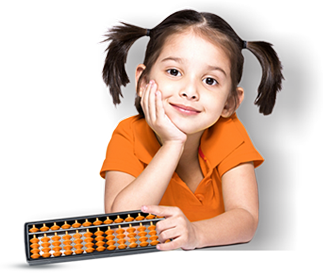




Confidence in childhood rarely appears overnight. It is often built quietly—when a child answers a question they once avoided, finishes a task without asking for help, or realizes, “I can actually do this.”
For children who hesitate in class, fear mistakes, or quickly say “I’m not good at math,” these small experiences of mastery can matter enormously. This is where UCMAS’s whole-brain development program can offer a different approach to learning.
Rather than focusing only on getting the correct answer, UCMAS uses structured abacus and mental math practice to develop skills such as concentration, memory, visualization, speed, accuracy, and self-confidence.
So, can mental math help children who lack confidence? Yes—but perhaps not for the reason parents first expect. It is not simply because children become faster at calculations. It is because repeated, visible progress gives them evidence that effort can turn something difficult into something manageable.
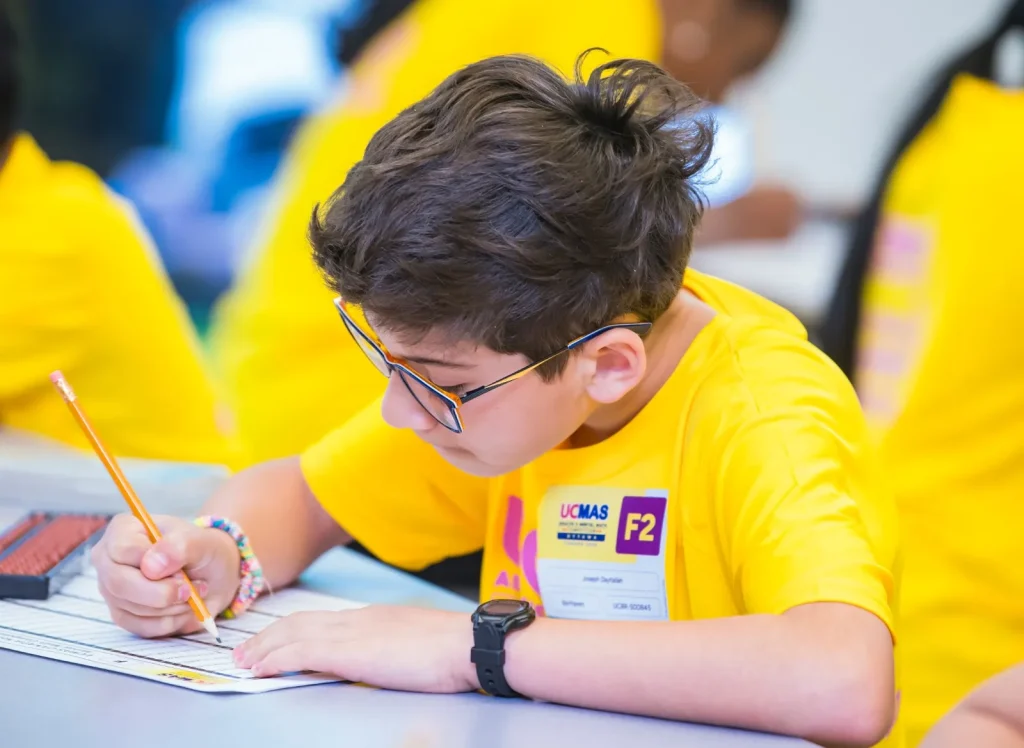
Why Do Some Children Lose Confidence in Learning?
A child does not have to be performing poorly to lack confidence.
Some children understand the lesson but are afraid to answer aloud. Others constantly compare themselves with faster classmates. A single mistake can make some children withdraw, while others become dependent on parents or teachers to confirm every answer.
Over time, thoughts such as “I’m slow,” “I’ll probably get it wrong,” or “Everyone else is better than me” can become part of how children see themselves.
This creates a difficult cycle:
Fear of mistakes → hesitation → less participation → fewer opportunities to succeed → even lower confidence.
Effective confidence building for kids therefore involves more than telling a child, “You can do it.” Children also need opportunities to experience themselves doing it.
That distinction is important.
Mental Math Creates Small Wins Children Can See
Imagine a child who initially needs an abacus to complete a calculation. With practice, the same child becomes quicker. Eventually, they begin visualizing the abacus and performing calculations mentally.
The improvement is tangible.
Yesterday, the calculation felt difficult. Today, it feels manageable. A few months later, the child may be solving problems they once thought were beyond them.
The UCMAS Mental Math Program for children begins with children physically manipulating abacus beads before progressing toward visualizing and manipulating a mental abacus. The program is designed to develop more than calculation speed, including concentration, memory, visualization, observation, and confidence.
For a child struggling with self-belief, that progression can provide something particularly valuable: proof of improvement.
Instead of simply hearing “You’re getting better,” children can experience it for themselves.
Confidence Grows When Children Stop Fearing Numbers
Math anxiety and low confidence can reinforce one another.
A child who believes they are “bad at math” may become nervous before even attempting a problem. That anxiety can make concentrating harder, and difficulty concentrating can then reinforce the belief that math is simply not for them.
Developing mental math for kids can help change this relationship by making numbers more familiar.
If you are wondering exactly how the skill works, this guide on mental math for elementary students explains how children can develop the ability to work with numbers mentally rather than relying entirely on written calculations.
As familiarity and competence increase, the question in a child’s mind can gradually shift from “What if I get this wrong?” to “Can I solve this?”
That is a small linguistic change but a meaningful confidence shift.
Better Concentration Can Make Children Feel More Capable
Sometimes what looks like a confidence problem is partly a focus problem.
A child misses an instruction, loses track halfway through a task, gets the wrong answer, and assumes they are not capable. When this happens repeatedly, confidence can decline even when the child has the ability to understand the material.
UCMAS activities require children to pay close attention to numbers, bead movements, visual representations, and instructions. The program specifically identifies sustained concentration as one of the skills developed through its training.
For parents searching for concentration improvement kids programs, this connection is worth considering. Better attention can help children complete tasks more independently, and independence itself can become a source of confidence.
Memory Can Influence Confidence Too
Consider two children who both learned something yesterday.
One recalls it quickly today. The other struggles to remember and immediately looks toward an adult for help.
Who is more likely to feel confident?
Memory and confidence are not the same skill, but they can influence each other. Children who can retrieve information more easily may feel more prepared to participate and tackle challenges independently.
In abacus mental math, children repeatedly recognize bead patterns, remember formulas, listen to numbers, visualize movements, and retrieve information while calculating. UCMAS describes memory development as one of the core cognitive skills supported by its physical and visual abacus activities.
Therefore, parents considering a memory improvement program for children can also look at the wider learning environment: Does it simply test memory, or does it give children meaningful opportunities to use and strengthen it?
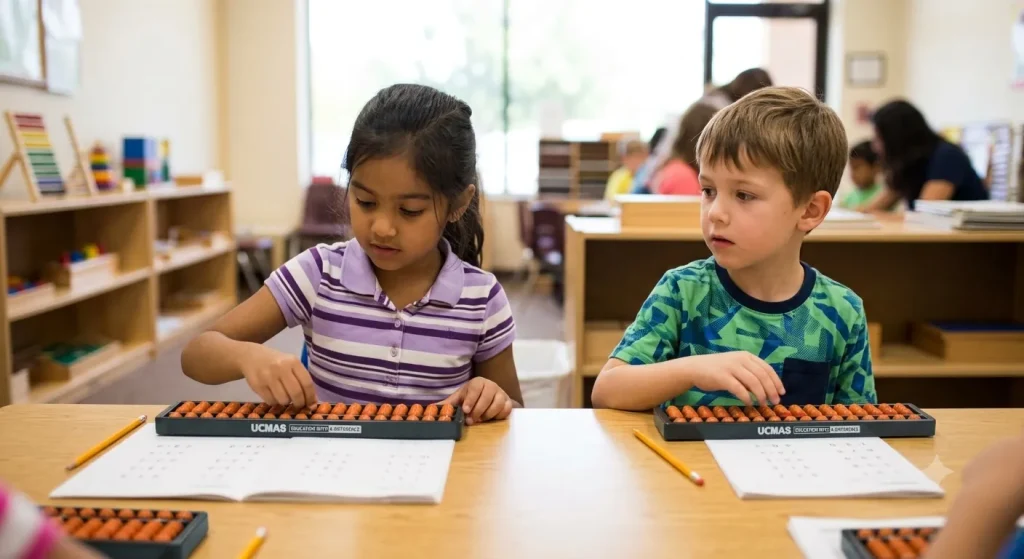
From “I Need Help” to “Let Me Try”
One of the most valuable signs of growing confidence is not always a perfect answer.
Sometimes, it is simply willingness to try.
When children repeatedly practise a skill at an appropriate level, challenges become less intimidating. They begin developing a history of overcoming things that initially seemed difficult.
That experience can encourage persistence:
“This looks difficult, but I’ve figured difficult things out before.”
A structured afterschool program designed to develop skills beyond academics can provide children with opportunities to practise in an environment outside regular classroom pressures. UCMAS describes its afterschool curriculum as progressively building mathematical ability alongside focus, problem-solving, and confidence.
That can be especially meaningful for a child who has already started identifying themselves as “the one who isn’t good at math.”
Mental Math Is Not the Same as Math Tuition
Parents may naturally wonder whether a child struggling with confidence simply needs tutoring.
That depends on the reason behind the struggle.
Traditional tuition often focuses on helping children understand school concepts, complete coursework, or improve grades. Mental math training has a different objective: strengthening calculation ability alongside broader cognitive skills.
The article Can Mental Math Replace Math Tuition? can help parents understand the distinction when deciding what kind of support their child needs.
For some children, improving marks may be the immediate priority. For others, the bigger need may be developing focus, independence, speed, and the confidence to approach problems without immediately assuming failure.
What Does Real Confidence Building Look Like?
Real confidence is not teaching children to believe they will always be right.
It is teaching them that being wrong does not mean they are incapable.
A confident learner can attempt something difficult, make an error, correct it, practise again, and keep going. That is why effective confidence building for kids should include challenge—not remove it completely.
Mental math provides frequent opportunities for this process. Children attempt calculations, notice errors, improve speed and accuracy, and gradually progress to more challenging work.
The UCMAS curriculum itself progresses through multiple levels, beginning with foundational arithmetic and moving toward increasingly complex mental calculations. Its advanced program benefits include improved self-esteem, confidence, and attention span.
The Bigger Goal: A Child Who Trusts Their Own Ability
The most meaningful outcome of learning is not a child who never needs help.
It is a child who does not automatically assume they cannot do something.
Mental math gives children measurable opportunities to watch themselves improve. When a calculation that once required effort becomes something they can complete mentally, they experience the relationship between practice and progress firsthand.
And that lesson extends far beyond arithmetic:
“I couldn’t do it before. I practised. Now I can.”
Parents who want more ideas for supporting their child’s learning can explore the UCMAS Reading Corner for parenting, learning, and child-development insights.
Confidence Is Built One “I Did It” at a Time
A confident child is not necessarily the loudest child in the classroom or the fastest child to raise their hand.
Confidence is often quieter. It is the willingness to try without knowing whether the answer will be right.
Through structured practice, progressive challenges, and visible improvement, UCMAS aims to help children strengthen not only their numerical abilities but also concentration, memory, problem-solving, and self-confidence.
For a child who frequently says “I can’t,” every independently solved problem can become evidence for a new belief:
“Maybe I can.”
Want to see how your child responds to abacus-based learning? Book a UCMAS abacus session and give them an opportunity to experience that first successful “I did it!” for themselves.