



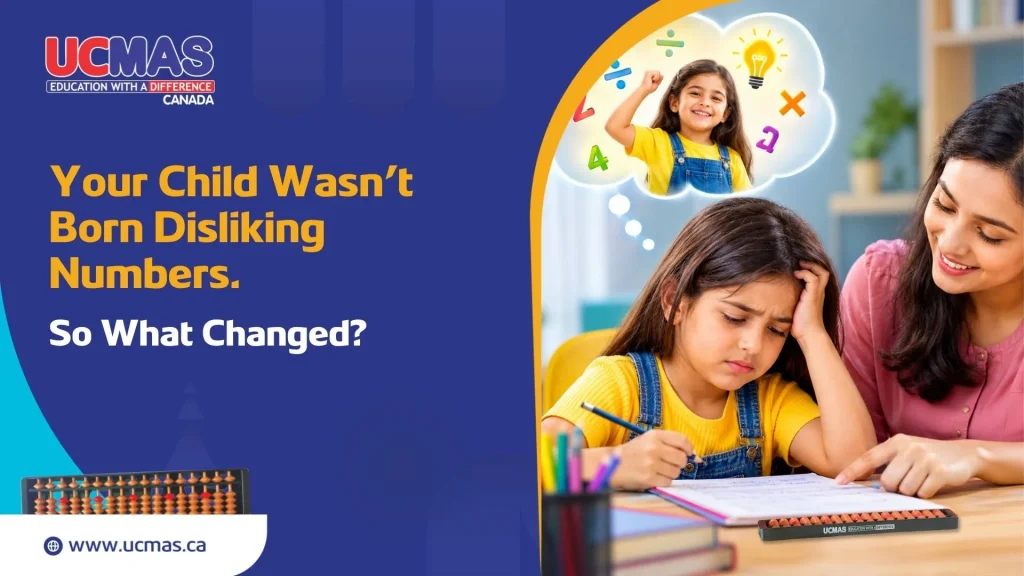
“I hate math.”
For a parent, those three words can be frustrating—and worrying. You may wonder whether your child is falling behind, needs a math tutor, or simply isn’t a “math person.”
But a dislike of math rarely appears out of nowhere. Sometimes children associate numbers with wrong answers, timed tests, comparison with classmates, confusing concepts, or repeated correction. Eventually, “This is difficult” can quietly become “I’m bad at this.”
That distinction matters.
Instead of immediately asking, “How do I make my child better at math?” parents may get further by asking, “What made math stop feeling safe, interesting, or achievable?”
At UCMAS Abacus and mental math learning for children, children aged 5–13 learn through abacus-based mental math designed to make calculation more visual and engaging while developing skills such as concentration, visualization, memory, and confidence.

First, Find Out What “I Hate Math” Really Means
When children say they hate math, resist the urge to immediately correct, lecture, or reassure them that math is important.
Instead, get curious.
Does your child struggle to keep up in class? Are multiplication tables frustrating? Do word problems feel overwhelming? Are they afraid of giving a wrong answer? Or have they started comparing themselves with a classmate who calculates faster?
A child who says “I hate math” may really mean:
- “I don’t understand what everyone else seems to understand.”
- “I’m scared I’ll get the answer wrong.”
- “It takes me longer than my friends.”
- “Practice is boring.”
- “I feel embarrassed when I make mistakes.”
Once you identify the source of the resistance, you can address the actual problem rather than simply adding more practice.
Don’t Turn Every Mistake Into a Big Deal
Imagine struggling with something and having someone watch, correct, and evaluate every attempt. It probably wouldn’t take long before you wanted to avoid it.
Children need room to be wrong.
Rather than saying, “No, that’s incorrect,” try asking, “Show me how you got that answer.” This shifts attention from performance to thinking.
A wrong answer can then become a puzzle instead of a failure.
This is especially important for children who already believe they are “bad at math.” Small successes can gradually challenge that belief, while constant emphasis on mistakes may reinforce it.
Make Math Something Children Can See and Experience
Numbers on a worksheet can feel abstract. That is one reason hands-on and visual approaches may give children a different entry point into mathematics.
In the UCMAS Mental Math Program, children begin by physically manipulating beads on an abacus and gradually learn to visualize the abacus mentally. The approach turns calculations into a visual process rather than relying exclusively on written arithmetic.
That can make mental math for kids feel less like another page of schoolwork and more like learning a new skill.
The goal shouldn’t simply be to convince a child that math is fun. Give them opportunities to experience it differently.
Replace “More Practice” With Better Practice
When a child struggles, the instinctive response is often more worksheets, more homework, and more repetition.
But if practice already feels stressful, simply increasing its quantity can deepen the resistance.
Try shorter, achievable practice instead. Ten or fifteen focused minutes may be more productive than an hour filled with arguments and frustration.
Parents looking for structured home activities can explore the UCMAS Mental Math Worksheets. The worksheets progress in complexity and include areas such as addition, subtraction, multiplication, division, and times tables.
Most importantly, end practice while your child still feels capable. A child who finishes thinking, “I did that!” is more likely to return tomorrow than one who finishes exhausted.
Celebrate Progress That Has Nothing to Do With Marks
A 90% test score is easy to celebrate. But what about the child who stayed with a difficult question instead of giving up?
That deserves attention too.
Praise effort, concentration, strategies, accuracy improvements, willingness to retry, and independent problem-solving. These smaller wins can help children see mathematical ability as something they can develop rather than something they either possess or don’t.
And the value can extend beyond school calculations. UCMAS discusses how mental math can contribute to lifelong success through skills including concentration, confidence, problem-solving, visualization, and mental calculation.
A Math Tutor Isn’t Always the Only Answer
A math tutor can be useful when a child has specific gaps in the school curriculum or needs one-to-one academic support.
But sometimes the problem is bigger than one chapter or one formula.
If your child understands concepts but freezes during calculations, gets distracted quickly, lacks confidence, or has developed a negative relationship with numbers, consider whether they need a different learning experience, not simply additional instruction.
A structured after school math program can introduce children to numbers outside the pressures associated with tests and grades.
UCMAS abacus classes, for example, use physical and visual calculation alongside interactive activities. UCMAS describes its training as incorporating tactile, auditory, and visual learning activities, giving children several ways to interact with mathematical information.
Work on the Skills Behind Math, Too
Struggling with mathematics isn’t always purely about arithmetic.
A child also needs to listen to instructions, remember steps, stay focused, recognize patterns, visualize information, and persist when the answer isn’t immediate.
That is why strengthening underlying learning skills can matter.
For example, How Abacus Training Improves Focus and Memory explains how abacus exercises involve sustained attention, visualization, recall, and active calculation.
Instead of treating math ability as an isolated school skill, parents can look at the broader set of cognitive habits that support learning.
Be Careful With the Language You Use Around Math
Parents sometimes say things like:
“I was terrible at math too.”
“Math just isn’t our family’s thing.”
“You’re more creative than mathematical.”
They may sound harmless—even comforting—but a child can interpret them as evidence that mathematical ability is fixed.
Try replacing labels with language about growth:
“You haven’t figured this out yet.”
“Let’s try another way.”
“That was difficult, but you stayed with it.”
The aim isn’t empty praise. It is helping children separate a temporary struggle from their identity.

Let Curiosity Replace Pressure
Math exists far beyond textbooks.
Let your child calculate change while shopping, estimate how long a journey will take, double a recipe, compare prices, keep score during a game, or calculate how much they need to save for something they want.
When numbers have a purpose, mathematics starts looking less like a school subject and more like a useful tool.
Parents can also explore the UCMAS Reading Corner for more ideas and insights around children’s learning, mathematics, and development.
From “I Hate Math” to “Let Me Try”
Your child does not need to fall in love with every equation.
A much better first goal is to move from avoidance to willingness—from “I can’t do this” to “Let me try.”
That change happens when children experience enough small victories to begin trusting themselves again.
The right approach combines patience at home, manageable practice, encouragement, and learning methods that make numbers less intimidating. Programs such as UCMAS can offer children a different way to experience mathematics—one built around abacus practice, visualization, mental calculation, and progressive skill development.
Because sometimes the answer to “My child hates math—what should I do?” isn’t more math.
It’s helping them experience math differently.
Ready to help your child build a more confident relationship with numbers? Explore the UCMAS After-School Math Program and discover an approach designed to develop mental calculation, problem-solving, concentration, and confidence.