



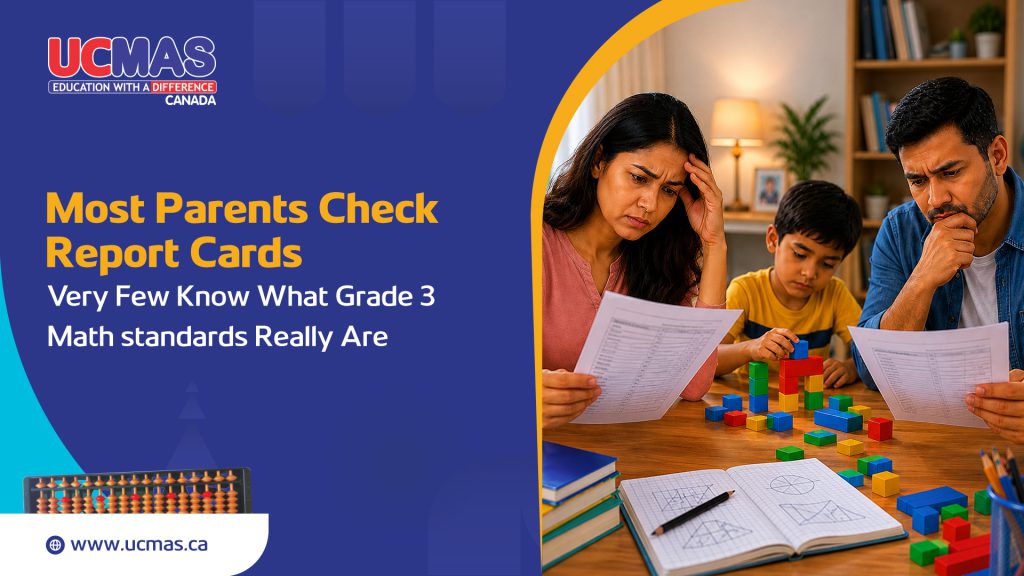
When Ontario parents think about academic milestones, Grade 3 often doesn’t receive the attention that high school or standardized testing gets.
Yet Grade 3 is one of the most important years in a child’s mathematical development.
This is the stage where students move beyond simple arithmetic and begin developing deeper problem-solving skills, stronger number sense, and mathematical reasoning. It is also the year many learning gaps become visible for the first time.
Programs like UCMAS focus on strengthening foundational thinking skills during these critical years, helping children build confidence before small struggles become larger academic challenges.
So how can you tell whether your child is truly meeting the Ontario Grade 3 math curriculum expectations?
Let’s break it down.
Why Grade 3 Matters More Than Most Parents Realize
Many parents view Grade 3 as simply another elementary school year.
Educators often see it differently.

Grade 3 represents a transition from learning basic math skills to applying those skills in increasingly complex situations. Students are expected to solve multi-step problems, explain their reasoning, identify patterns, work with fractions, and use mathematical thinking independently.
A child who develops strong foundations in Grade 3 is typically better prepared for:
- Upper elementary mathematics
- EQAO assessments
- Algebraic thinking
- Financial literacy concepts
- STEM-related learning later in school
When foundational gaps appear during this stage, they often compound in Grades 4, 5, and 6.
Understanding Ontario Grade 3 Math Curriculum Expectations
The Ontario Grade 3 math curriculum expectations are organized around several key learning areas.
1. Number Sense and Operations
Students should be able to:
- Read, represent, compare, and order numbers
- Understand place value concepts
- Add and subtract larger numbers
- Develop multiplication and division understanding
- Use mental math strategies effectively
At this stage, children should begin seeing relationships between numbers rather than relying solely on counting methods.
2. Fractions
Grade 3 introduces important fraction concepts.
Students learn to:
- Identify fractions as equal parts of a whole
- Compare simple fractions
- Represent fractions visually
- Connect fractions to real-life situations
Many children find this concept challenging because it requires a shift in thinking beyond whole numbers.
3. Patterning and Algebra
Students begin exploring:
- Number patterns
- Growing patterns
- Mathematical relationships
- Predicting future values
This early exposure builds the foundation for future algebra courses.
4. Measurement
Students should understand:
- Length
- Area
- Mass
- Capacity
- Time
More importantly, they should be able to apply these concepts to solve practical problems.
5. Data and Probability
Children learn to:
- Collect information
- Organize data
- Interpret graphs
- Draw conclusions from data sets
These skills support analytical thinking far beyond mathematics.
6. Spatial Sense and Geometry
Students are expected to:
- Identify geometric shapes
- Recognize symmetry
- Understand positional relationships
- Visualize shapes and structures
These concepts contribute significantly to visual-spatial development.
Signs Your Child Is On Track
Parents often wonder what successful Grade 3 math performance actually looks like.

Children who are meeting expectations typically:
- Solve basic calculations with confidence
- Explain how they reached an answer
- Recognize patterns quickly
- Show curiosity toward problem-solving
- Complete age-appropriate math homework independently
- Demonstrate growing mental math ability
Perfection isn’t required.
What matters is steady progress and increasing confidence.
Warning Signs Your Child May Be Falling Behind
Sometimes struggles aren’t obvious from report cards alone.
Watch for signs such as:
1. Difficulty With Basic Number Facts
If multiplication and addition facts remain extremely challenging, future topics often become harder.
2. Heavy Reliance on Fingers
Occasional counting is normal.
Consistent finger counting for simple calculations may indicate weak number sense.
3. Avoidance of Math Activities
Children who regularly avoid math homework or become frustrated may be experiencing deeper learning challenges.
4. Trouble Explaining Answers
A child might arrive at a correct answer but struggle to explain their reasoning.
Ontario’s curriculum increasingly emphasizes mathematical thinking and communication.
5. Low Confidence
Confidence often predicts performance.
Students who repeatedly say “I’m bad at math” may need additional support before negative beliefs become permanent.
Why Many Ontario Students Struggle With Math
The reality is that many students face challenges despite receiving classroom instruction.
Several factors contribute:
- Large classroom sizes
- Different learning speeds
- Limited individualized attention
- Reduced opportunities for repetitive skill-building
- Math anxiety
This challenge becomes especially visible during provincial assessments.
Parents interested in understanding these trends can explore this article on why Ontario students struggle with EQAO math tests.
The Role of Mental Math in Grade 3 Success
One of the biggest differences between strong and struggling students often comes down to mental math.
Children with strong mental calculation abilities can:
- Process information faster
- Focus on problem-solving instead of calculations
- Build greater confidence
- Reduce test anxiety
- Develop stronger number sense
Mental math is not about speed alone.
It is about understanding numbers deeply enough to manipulate them efficiently.
This is one reason many educators and parents increasingly explore enrichment programs that focus on cognitive skill development alongside classroom learning.
How Abacus Training Supports Mathematical Development
Abacus learning goes beyond arithmetic.
Research suggests that structured abacus practice can strengthen:
- Concentration
- Working memory
- Visualization skills
- Numerical reasoning
- Problem-solving abilities
Parents interested in the science behind this approach can read more about how abacus training shapes a child’s brain.
These cognitive benefits often transfer into classroom performance across multiple subjects.
What Growth Can Look Like Between Grades 3 and 6
Grade 3 is not the destination.
It is the beginning of a longer learning journey.
Students who build strong foundations during Grade 3 often demonstrate substantial growth by the time they reach middle elementary years.
This progression becomes particularly evident in areas such as:
- Independent problem-solving
- Mathematical confidence
- Mental calculation
- Academic resilience
Parents can explore a typical development pathway in this UCMAS growth story guide from grade 3 to 6.
How Parents Can Support Grade 3 Math Learning at Home
You do not need to become a math teacher.
Small daily habits often create the greatest impact.
Encourage Mental Math
Ask quick questions during everyday activities.
Examples include:
- Calculating grocery totals
- Estimating distances
- Counting change
Focus on Understanding
Avoid memorization without comprehension.
Ask:
“What made you choose that answer?”
Make Math Visible
Use clocks, calendars, recipes, and shopping trips as opportunities to discuss numbers.
Celebrate Effort
Praise persistence and problem-solving rather than only correct answers.
Consider Enrichment Support
Additional structured learning can help children strengthen skills and confidence while staying aligned with classroom expectations.
Looking Beyond Report Cards
A report card provides useful information.
But it rarely tells the full story.
A child earning satisfactory grades may still have gaps in confidence, reasoning, or mental calculation skills that become more noticeable in later grades.
The most effective approach is to regularly evaluate whether your child can:
- Think independently
- Explain their reasoning
- Solve unfamiliar problems
- Apply math in everyday situations
These abilities reflect true mathematical understanding.
Helping Your Child Build a Strong Mathematical Future
The Ontario Grade 3 math curriculum expectations serve as an important benchmark, but they are only one part of your child’s learning journey.
Children who develop strong number sense, confidence, concentration, and problem-solving abilities today are often better prepared for tomorrow’s academic challenges.
Whether your goal is stronger classroom performance, improved confidence, or preparation for future standardized assessments, early support can make a significant difference.
Explore more resources at UCMAS and help your child build a stronger foundation for lifelong learning.
Book a free abacus session and discover how UCMAS can support your child’s mathematical growth, confidence, concentration, and mental calculation skills.