





September feels like a fresh start. Children return to classrooms, settle into new schedules, meet new teachers and gradually discover what the academic year will demand from them. Parents, meanwhile, are busy rebuilding routines around school, homework, activities and bedtime.
But there is another back-to-school priority worth considering: preparing the brain for learning.
This makes September an excellent time to introduce brain training for kids. Rather than waiting until a child struggles with homework, attention or academic pressure, parents can use the beginning of the school year to strengthen foundational learning abilities. Programs such as UCMAS focus on developing mental abilities that children can carry into the classroom and beyond.
September Naturally Creates a “Fresh Start” Mindset
Children already expect change in September. A different classroom, new timetable and new learning goals make adapting to routines a natural part of the month.
That makes it easier to introduce something new without making it feel like a response to poor grades.
Back to school brain training can simply become another positive part of the child’s weekly routine. Instead of saying, “You need extra help because you are struggling,” parents can frame it as, “Here is something that can help make your brain stronger for the new school year.”
Starting early also gives children time to develop their abilities before academic demands intensify later in the term.

School Requires More Than Academic Knowledge
Knowing multiplication tables or spelling words is important, but classroom success also depends on how effectively children can use their minds.
They need to listen carefully, remember instructions, switch between tasks, process information and stay attentive even when something feels difficult.
These underlying cognitive skills for kids influence how effectively they engage with everyday learning. That is why September is a useful time to look beyond subject-specific tutoring and consider broader cognitive development.
As discussed in 2026 Skills for Kids, abilities such as critical thinking, adaptability, focus and problem-solving are increasingly valuable for children preparing for a changing world.
Focus Is a Skill Children Can Practice
A child who gets distracted easily is not necessarily uninterested in learning. Concentration itself requires practice.
Structured mental exercises encourage children to stay engaged with a task, process information and complete a sequence without constantly shifting their attention elsewhere. This is one reason parents may explore focus classes for children when building their back-to-school routine.
Abacus practice is particularly interesting because children must pay attention while seeing, hearing, calculating and responding. With continued practice, they gradually learn to sustain their attention during increasingly challenging exercises.
For parents interested in concentration improvement kids can work toward through structured practice, How Abacus Helps Improve Focus & Memory explains how abacus-based activities can support these abilities.
Memory Matters Every Single School Day
Think about how often children use memory during one school day.
They remember a teacher’s instructions, retrieve previously learned information, follow several steps in a math problem and connect a new concept with something taught last week.
A memory improvement program children participate in should therefore do more than encourage memorization. The goal is to repeatedly exercise the ability to receive, retain, retrieve and work with information.
Abacus and mental arithmetic can provide this kind of practice. As children progress, they may begin visualizing the abacus and performing calculations mentally. You can explore the relationship between this practice and cognitive development in How Abacus Training Shapes Child Brain.
Abacus Training Engages Multiple Mental Processes
One reason abacus learning stands out among brain development activities is that a seemingly simple calculation can involve several mental processes.
A child may need to listen to numbers, visualize movement, recall rules, maintain attention and calculate accurately, sometimes within a limited amount of time.
Repeated practice can challenge several abilities rather than isolating just one academic topic.
The Abacus Training & Brain Development resource explores how this learning method engages children’s mental processes and supports broader development.
This also explains why abacus learning should not be viewed simply as a way to become faster at arithmetic. The calculation is the activity, but the abilities being exercised can extend beyond math.
September Gives Children Time to Build Before Pressure Builds
Waiting until report cards arrive can turn learning support into a reaction to a problem.
September offers a different approach.
Children can begin practicing focus, memory and mental calculation while the school year is still taking shape. By establishing a routine early, parents give children more time to become comfortable with regular mental practice.
The UCMAS Mental Math Program uses abacus-based learning and mental arithmetic to help children develop concentration, memory, visualization and calculation abilities in a structured environment.
The key is consistency. Brain training is not a one-week shortcut to better grades. Like learning an instrument or improving at a sport, cognitive development benefits from regular practice over time.
Make Brain Training Part of the Back-to-School Routine
September schedules can quickly become crowded, so adding more activities is not always the answer. What matters is choosing activities with a clear purpose.
Parents can combine structured training with simple everyday habits such as puzzles, reading, memory games, mental calculations, strategy games and screen-free problem-solving.
Keep sessions age-appropriate and manageable. Ten focused minutes can sometimes be more productive than a long session during which a tired child loses interest.
Most importantly, focus on progress rather than perfection. Brain training should encourage children to challenge themselves, make mistakes, try again and gradually become more confident with difficult tasks.
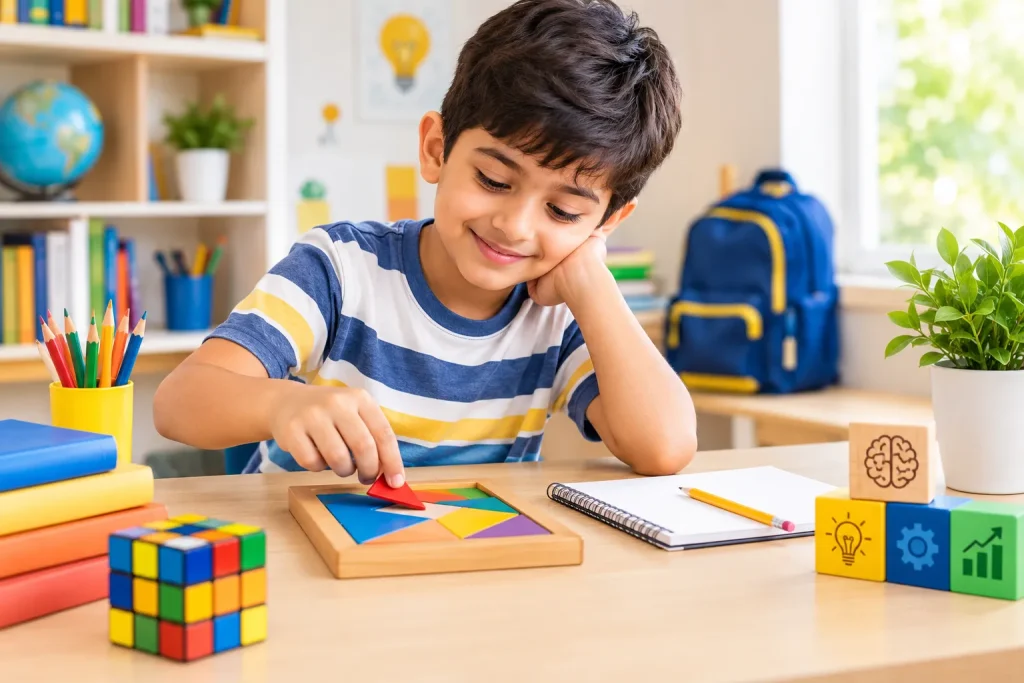
A Strong School Year Can Start With a Stronger Learning Routine
September is not just the month children return to school. It is the month families decide what the new school-year routine will look like.
That makes it an ideal opportunity to prioritize abilities that support learning throughout the year. Brain training for kids can help children practice attention, memory, visualization, mental processing and problem-solving while they are already adapting to fresh routines.
Rather than waiting for academic difficulties to appear, parents can use September proactively. With structured practice, supportive expectations and the right learning environment, children can work toward becoming more focused, confident and independent learners.
Explore UCMAS to learn how abacus and mental arithmetic programs can become part of your child’s learning journey.
Book an Abacus Session with UCMAS and discover how structured mental practice can support the skills they use every day.