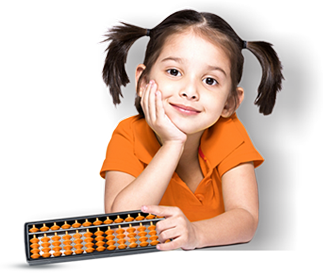





Choosing the right learning program can feel overwhelming for parents. Both UCMAS and Kumon have helped millions of children worldwide, yet they follow very different educational philosophies. While one focuses on repetition and practice, the other develops the brain’s ability to visualize, calculate, and think quickly.
If your goal is simply better school marks, either program can provide support. However, if you’re looking for faster math improvement along with stronger memory, concentration, and confidence, understanding how these programs work becomes essential.
UCMAS, available across Canada, combines structured abacus mental math with whole-brain development to help children solve calculations mentally while strengthening important cognitive skills.
Let’s compare both programs to help you make an informed decision.
Understanding the Difference Between UCMAS and Kumon
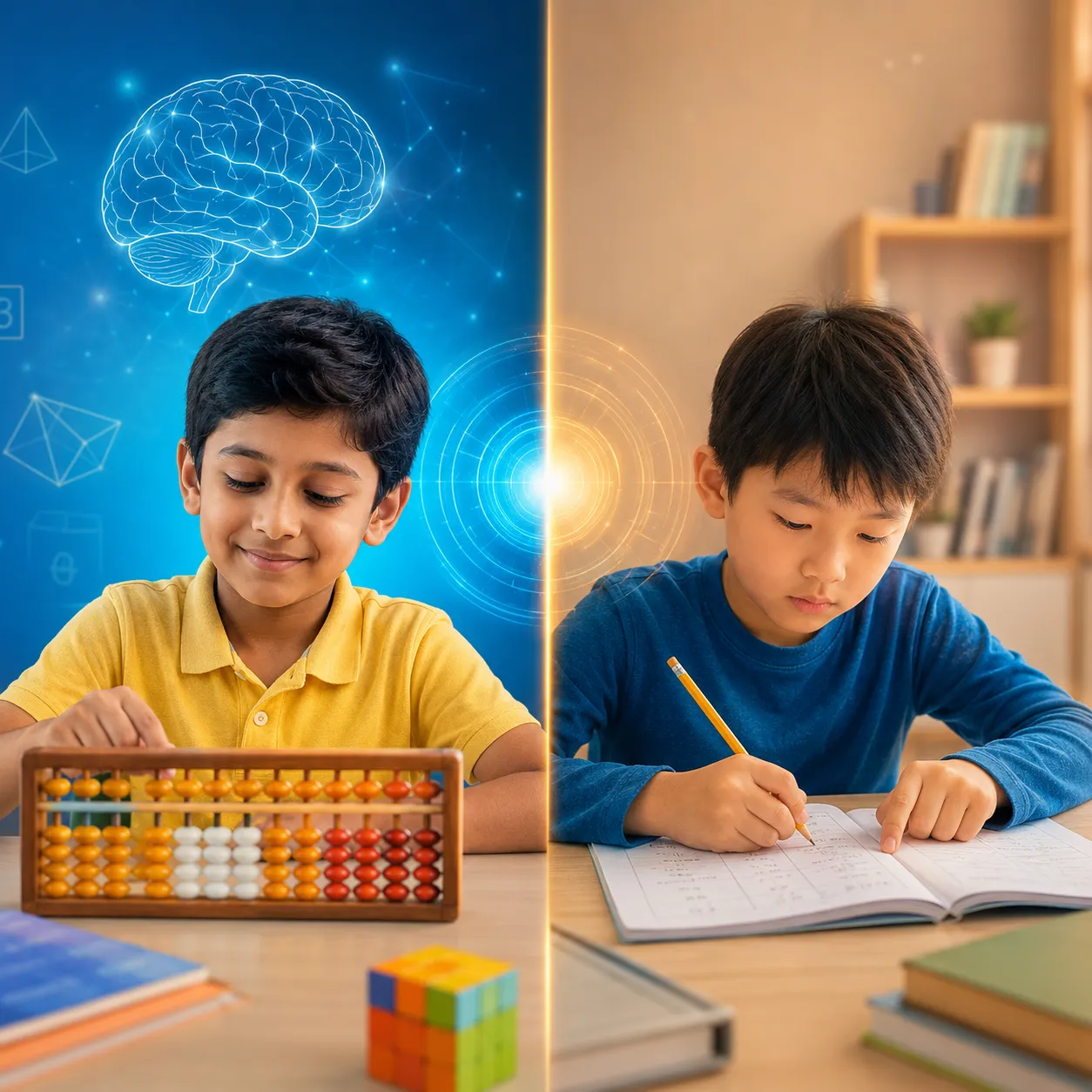
Although both programs aim to improve mathematical ability, they use completely different methods.
| UCMAS | Kumon |
| Uses physical and visual abacus training | Uses worksheets and repetition |
| Focuses on visualization and brain development | Focuses on mastering academic curriculum |
| Develops calculation speed mentally | Develops accuracy through repeated practice |
| Encourages whole-brain development | Emphasizes sequential learning |
This distinction explains why discussions around UCMAS vs Kumon often depend on what parents want their children to achieve.
How UCMAS Develops Mental Math
The UCMAS abacus math course begins with a physical abacus. As children gain confidence, they gradually transition to solving calculations by imagining the beads mentally.
This process strengthens visualization, working memory, concentration, and processing speed simultaneously.
Instead of memorizing procedures, children learn to “see” numbers inside their minds. Over time, calculations become remarkably fast without relying on paper, calculators, or fingers.
The result is not just better arithmetic—but improved cognitive learning across many areas of education.
Parents interested in understanding the fundamentals can explore the guide on What Is Mental Math for Elementary Students?
How Kumon Builds Math Skills
Kumon follows a different philosophy.
Children complete progressively challenging worksheets every day. The emphasis is on repetition, consistency, and independent learning.
This method helps students master school mathematics, improve discipline, and strengthen procedural understanding.
For many students who require additional math tutoring, Kumon provides valuable reinforcement of classroom concepts.
However, worksheet-based learning does not specifically train visualization or whole-brain development in the same way as structured abacus training.
Which Program Improves Mental Math Faster?
When parents ask which program delivers faster mental calculations, the learning methods provide the answer.
UCMAS directly teaches children how to perform calculations mentally using visualization techniques.
Kumon develops mathematical proficiency through repeated written practice.
Since UCMAS specifically trains children to calculate mentally rather than rely on written methods, many students demonstrate noticeable improvements in calculation speed after progressing through the program.
This is why many families searching for effective mental math courses choose UCMAS when rapid mental calculation is their primary goal.
Beyond Faster Calculations: Whole-Brain Development
One of the biggest differences lies beyond mathematics itself.
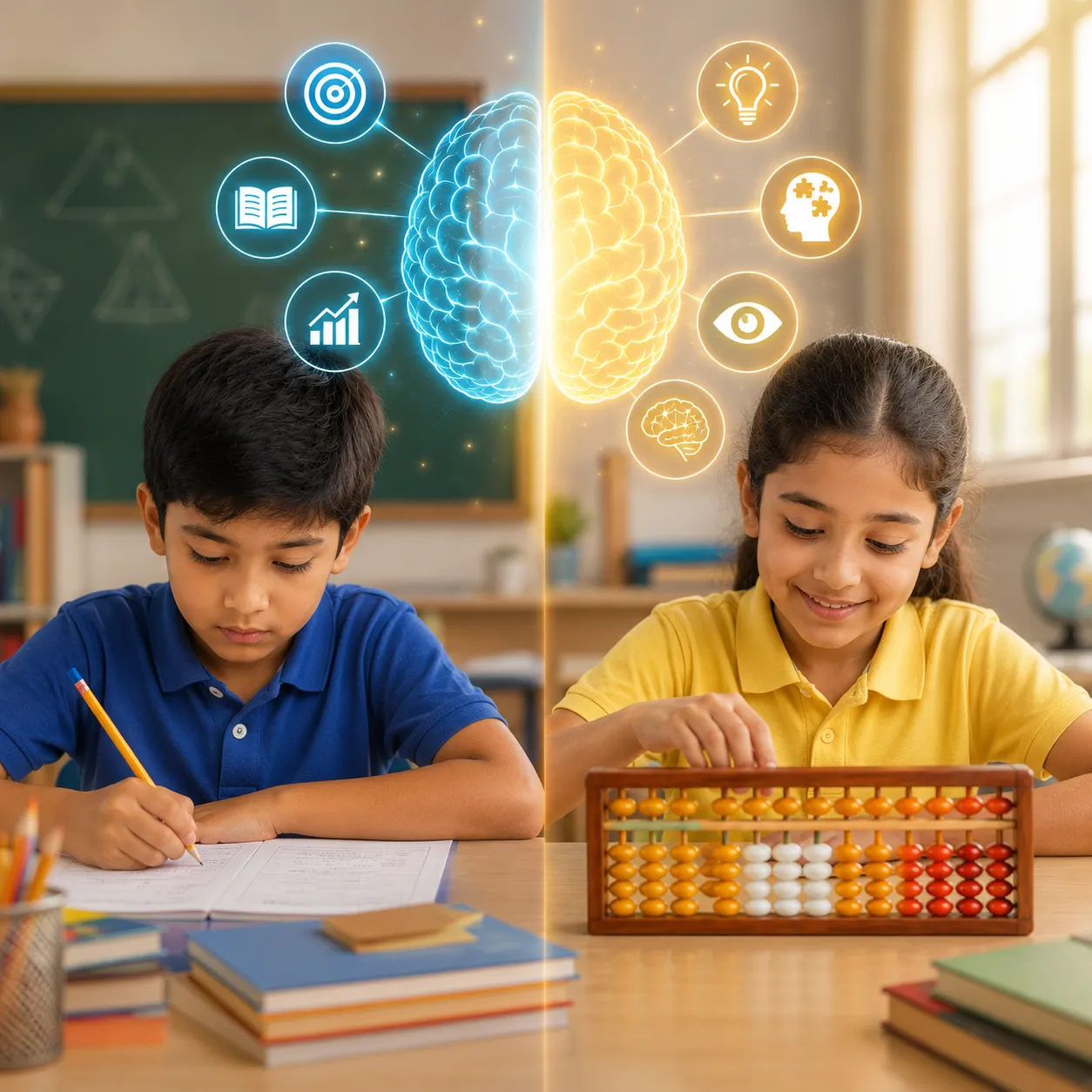
Regular abacus training stimulates both hemispheres of the brain by combining movement, visualization, listening, memory, and concentration during learning.
Parents frequently notice improvements in:
- Attention span
- Memory retention
- Listening skills
- Confidence
- Problem-solving ability
- Classroom participation
These broader benefits make UCMAS much more than a traditional mental arithmetic course.
To understand why developing these abilities early matters, read Why Mental Math Before Grade 3 Matters.
Which Program Better Supports School Performance?
Both programs can positively influence school performance—but differently.
Kumon aligns closely with academic mathematics through extensive worksheet practice.
UCMAS strengthens the underlying cognitive abilities that help children perform better across multiple subjects.
Students who develop stronger concentration, memory, visualization, and faster processing often become more confident learners overall.
Many educators observe that children with stronger mental processing frequently find classroom learning easier, even outside mathematics.
Confidence Makes a Bigger Difference Than Most Parents Realize
Many children fear mathematics because calculations feel slow or difficult.
As their speed improves through regular mental practice, hesitation gradually disappears.
Children who solve problems quickly often become more willing to participate in class, attempt challenging questions, and approach learning with enthusiasm.
Parents commonly report that confidence grows alongside improved calculation ability—a benefit that extends well beyond mathematics.
This Parent’s Handbook to Mental Math explains how these changes develop throughout a child’s learning journey.
Which Program Is Right for Your Child?
The answer depends on your child’s goals.
Choose Kumon if your primary objective is reinforcing school curriculum through consistent worksheet practice.
Choose UCMAS if you want your child to:
- Calculate mentally with speed and accuracy
- Strengthen memory and concentration
- Develop visualization skills
- Improve confidence
- Build lifelong cognitive abilities alongside mathematics
Parents comparing different enrichment programs may also read these guides on UCMAS vs Mathnasium vs Kumon Canada and UCMAS vs Russian Math vs Spirit of Math.
Choosing the Right Learning Journey for Your Kids
There is no universal “best” program—only the best program for your child’s needs.
If classroom reinforcement and repetition are your priorities, Kumon offers a structured approach.
If your goal is faster mental calculations, stronger visualization, improved memory, and broader brain development, UCMAS provides a unique learning experience built around abacus mental math.
Thousands of Canadian families have chosen UCMAS because it develops not only mathematical ability but also the cognitive skills children use throughout their academic journey.
Visit UCMAS Canada or Book a Free Abacus Session if you’d like your child to experience the program firsthand and see the difference.