




Starting a business is often seen as a bold move, one filled with opportunity, but also uncertainty. In Ontario’s competitive and evolving economy, aspiring entrepreneurs are constantly searching for the best franchise to open Ontario and business models that offer stability, predictability, and long-term growth. Among the many options available, education franchises have emerged as a compelling choice.
From tutoring centers and STEM programs to after-school enrichment hubs, education franchises are gaining momentum across the province. But the real question is: Are they truly the lowest-risk business you can open in Ontario right now?
While no business is completely risk-free, education franchises come remarkably close to offering a balanced mix of demand, structure, and support. Understanding why requires a closer look at market demand, operational advantages, and the inherent benefits of franchising.
The Growing Demand for Supplementary Education
Ontario has witnessed a significant rise in demand for supplementary education over the past decade. This growth is driven by several interconnected factors that continue to shape the academic landscape.
Increasing Academic Pressure
Students today face higher expectations than ever before. Competitive university admissions, standardized testing, and evolving curriculum standards have pushed parents to seek additional academic support for their children. Tutoring and enrichment programs are no longer seen as optional; they are increasingly viewed as essential.
Larger Class Sizes and Limited Individual Attention
In many schools, larger class sizes make it difficult for teachers to provide personalized attention to every student. As a result, parents turn to external education providers to fill this gap. Education franchises are uniquely positioned to offer structured, small-group, or one-on-one learning environments.
Rise of STEM and Skill-Based Learning
There is a growing emphasis on STEM (Science, Technology, Engineering, and Mathematics) education, coding, and critical thinking skills. Traditional schooling often cannot fully address these areas, creating a strong demand for specialized programs offered by education franchises.
Post-Pandemic Learning Gaps
The pandemic created noticeable learning disruptions. Many students experienced setbacks in foundational skills, particularly in subjects like math and reading. Even years later, parents are actively seeking programs to help their children catch up and stay ahead.
Cultural Emphasis on Education
Ontario’s diverse population includes many families who place a high value on academic achievement. This cultural mindset further fuels demand for supplemental education services, making the industry resilient and consistently relevant.
How Franchising Helps Reduce Business Risk and Costs
One of the biggest reasons education franchises are considered low-risk is the franchising model itself. Starting an independent business involves trial and error, but franchising significantly reduces uncertainty.
Proven Business Model
Franchises operate on systems that have already been tested and refined. This means you are not experimenting with pricing, curriculum, or marketing strategies; you are implementing what has already worked in multiple locations.
This dramatically reduces the likelihood of early-stage failure, which is one of the biggest risks in entrepreneurship.
Lower Trial-and-Error Costs
Independent businesses often spend heavily on experimentation; testing marketing campaigns, refining services, and adjusting operations. In a franchise, these elements are already optimized.
As a result, you save both time and money, reducing the overall cost of launching and stabilizing the business.
Streamlined Operations
Education franchises typically have standardized processes for:
- Student enrollment
- Curriculum delivery
- Staff training
- Scheduling and reporting
This operational clarity minimizes inefficiencies and reduces the risk of costly mistakes.
SReduced Marketing Risk
Building a brand from scratch can be expensive and unpredictable. Franchises come with established branding, marketing strategies, and often national or regional campaigns.
This allows you to attract customers faster and more efficiently, lowering customer acquisition costs.
Support and Training
Franchisors provide ongoing support in areas such as:
- Site selection
- Staff hiring and training
- Marketing execution
- Business operations
This guidance acts as a safety net, especially for first-time entrepreneurs, helping them navigate challenges with confidence.

Key Reasons Education Franchises Are Considered Low-Risk
Beyond the advantages of franchising itself, the fundamental nature of the education industry plays a major role in reducing business risk. Unlike many sectors that are influenced by trends, consumer moods, or seasonal demand, education operates on a long-term, need-based model. This inherent stability is what makes education franchises particularly attractive to entrepreneurs seeking predictable and sustainable returns.
1. Consistent and Recurring Demand
One of the strongest factors contributing to the low-risk nature of education franchises is the consistency of demand. Education is not driven by trends or short-term consumer interests; it is a continuous requirement.
Students need academic support across multiple years, often progressing from primary school through high school. This creates a long customer lifecycle, where a single student may remain enrolled for several years. As a result, businesses are not constantly chasing new customers to stay afloat.
Unlike industries where revenue fluctuates dramatically, education franchises benefit from a steady inflow of income, making cash flow more stable and manageable.
2. Essential Service Nature
Education is widely regarded as a necessity rather than a luxury. Parents view spending on their children’s learning as an investment, not an expense.
Even during economic downturns, families tend to cut back on discretionary spending such as dining out, travel, or retail purchases, but continue investing in education. In many cases, demand for tutoring and academic support actually increases during uncertain times, as parents seek to give their children a competitive advantage.
This essential nature provides a level of economic resilience that few industries can match. While other businesses may struggle during downturns, education franchises often maintain steady demand, making them less vulnerable to market fluctuations.
3. Minimal Inventory Requirements
Unlike retail or manufacturing businesses, education franchises do not depend on physical inventory. There are no products to stock, manage, or sell.
This eliminates several common business risks, including:
- Unsold inventory and dead stock
- Storage and warehousing costs
- Supply chain disruptions
- Product obsolescence or spoilage
Instead, the primary “product” is knowledge and instruction, which requires far fewer physical resources. This significantly lowers upfront investment and ongoing operational costs.
Additionally, the absence of inventory simplifies day-to-day operations. Business owners can focus on service delivery and customer experience rather than logistics and stock management.
4. Smaller and More Manageable Teams
Education franchises typically operate with lean staffing structures. A small team of qualified instructors, supported by an administrator or center manager, is often sufficient to handle daily operations.
This has several advantages:
- Lower payroll expenses compared to labor-intensive industries
- Easier team management and communication
- Reduced hiring complexity
- Greater control over service quality
For franchise owners, this translates into a more manageable business model where operational oversight is simpler and more efficient.
5. Flexible and Adaptive Business Models
Modern education franchises are designed with flexibility in mind. They are no longer limited to traditional classroom setups but can operate across multiple formats, including:
- In-center learning: Structured, face-to-face sessions
- Online classes: Virtual learning environments accessible from anywhere
- Hybrid models: A combination of in-person and digital instruction
This flexibility allows businesses to adapt quickly to changing circumstances, whether due to technological shifts, market preferences, or external disruptions.
For example, during periods when physical centers may face limitations, online learning ensures continuity. Similarly, hybrid models provide convenience to families while maximizing operational efficiency.
This adaptability not only reduces risk but also opens up opportunities for expansion beyond geographical boundaries.
Education franchise Ontario is not just structured well because of franchising; they are supported by an industry that naturally favors long-term sustainability. This dual advantage is what positions them as one of the most reliable business opportunities in Ontario today.
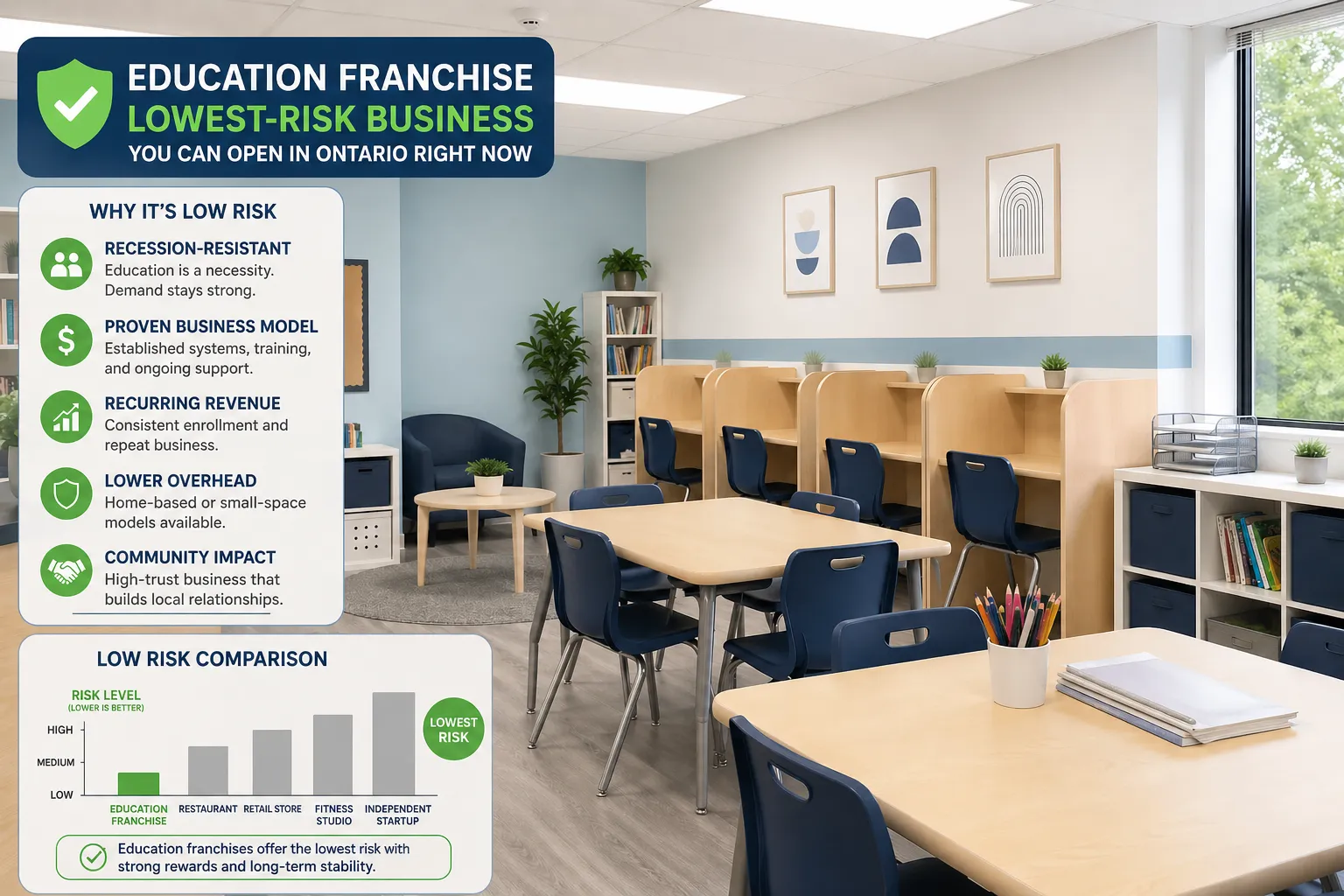
Comparing Education Franchises
| Business Type | Startup Reality | Operational Challenges | Risk Level |
| Restaurants | High initial investment with setup, interiors, and licensing | Perishable inventory, complex daily operations, staff-heavy | High Risk – Even small disruptions can impact profitability |
| Retail Businesses | Moderate to high investment depending on inventory and location | Managing stock, adapting to trends, and competing with e-commerce | High to Medium Risk – Revenue can fluctuate with market changes |
| Independent Startups | Flexible entry, but requires building everything from scratch | No proven systems, high marketing effort, trial-and-error execution | High Risk – Success depends heavily on experimentation |
| Education Franchises | Structured setup with proven systems and brand support | Streamlined operations, smaller teams, minimal inventory | Low Risk – Predictable demand and recurring revenue |
What Makes an Education Franchise Truly Low-Risk?
While the category itself is relatively safe, not all education franchises offer the same level of security. Choosing the right opportunity is critical.
A well-established brand builds immediate trust with parents and reduces the time needed to attract students.
Recurring Revenue Structure
Programs that encourage long-term enrollment provide financial stability and reduce income fluctuations.

Comprehensive Training and Support
The more support a franchisor provides, the easier it is to manage operations and avoid common pitfalls.
Scalability
Franchises that allow expansion—either through more students or additional locations—offer better long-term returns.
Local Market Alignment
Understanding the local market is essential. Areas with higher population density, strong school networks, and family-oriented communities tend to perform better.
The Ontario Advantage
Ontario is particularly well-suited for education franchises due to several key factors:
- A large and growing population
- High emphasis on education and academic success
- Diverse communities with strong learning cultures
- Urban centers with dense student populations
These conditions create a fertile environment for education businesses to thrive.
Why Education Franchises Remain a Safe Bet in Uncertain Times
In a business landscape where uncertainty has become the norm, choosing the right model is more important than ever. Education franchises Ontario stand out because they combine consistent demand, structured systems, and long-term relevance, making them one of the most dependable pathways into entrepreneurship in Ontario.
Among the many options available, UCMAS offers a particularly compelling case. Built around the proven effectiveness of abacus-based mental math training, the model taps into a universal parental priority: strengthening foundational skills like concentration, memory, and numerical ability.
What makes the UCMAS model especially suited for uncertain times is its structured yet adaptable approach. With a standardized curriculum, established brand credibility, and a focus on skill development rather than curriculum dependency, it allows franchise owners to operate with clarity and confidence.
Additionally, the emphasis on long-term student engagement creates recurring revenue, while the relatively lean operational model keeps overheads manageable. This balance between stability and scalability is what many entrepreneurs seek but rarely find in other industries.
Ultimately, while no business is entirely risk-free, choosing a model like UCMAS significantly tilts the odds in your favor. Start your journey with UCMAS and build a business designed to thrive, even in uncertain times.