


In every generation, parents search for that one advantage, the edge that helps their children move from simply keeping up to truly standing out. As academic expectations continue to evolve, so do the questions families are asking. What does real academic excellence for kids look like? Is it reflected only in report cards, or does it go deeper than grades?
Elementary school years are the foundation for forming habits, shaping confidence, and shaping attitudes toward learning. In regions like the Greater Toronto Area (GTA), where educational standards are high and classrooms are increasingly competitive, building a strong academic base early has never been more important.
Yet many parents sense that classroom instruction alone may not be enough. They look for structured enrichment that strengthens focus, sharpens thinking, and nurtures resilience, without overwhelming their child. The goal isn’t just better scores; it’s stronger learners.
Let’s take a closer look at what academic excellence for kids truly means for elementary students, the challenges children face today, and how the right early intervention can quietly transform a child’s learning journey.
What Does Academic Excellence Really Mean?
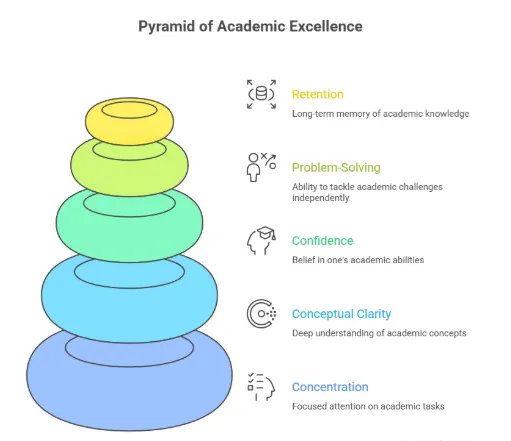
Academic excellence is a phrase often used by educators and parents, but what does it truly encompass? At its core, academic excellence is not just about achieving high grades or test scores. It involves:
- Deep understanding of concepts
- Critical thinking and problem-solving skills
- Consistent academic growth
- Self-confidence and motivation to learn
- Effective study habits and time management
Academic excellence means that a student not only absorbs information but also understands it, applies it, and can build on it to solve new problems. It’s about nurturing a lifelong love of learning rather than just memorizing facts for a test.
In elementary education, academic excellence lays the foundation for future success. During this timeframe, children develop essential skills in reading, writing, mathematics, and reasoning. These early years set the trajectory for middle school, high school, and beyond.
Academic Challenges Observed in the GTA
The GTA is one of Canada’s most diverse and dynamic regions, with families from a wide range of cultural, linguistic, and socioeconomic backgrounds. While this diversity is a tremendous strength, it also brings unique educational challenges, especially at the elementary level:
1. Varied Learning Readiness
Children enter school with very different preparation levels. Some have access to early learning resources and support at home, while others may struggle to build foundational skills before Grade 1.
2. Overemphasis on Test Results
With standardized tests, report cards, and competitive academic tracks, many students feel pressure to perform rather than learn.
3. Math Anxiety
Many young learners develop anxiety around mathematics early on. Even students who do well in other subjects can struggle with confidence when it comes to numbers.
4. Attention and Focus Challenges
In an age of digital distractions, maintaining focus during classwork and homework is a growing concern for educators and parents alike.
5. Language Barriers
For families whose first language is not English, navigating elementary school expectations, especially in reading and word problems, can be a challenge.
6. Time Constraints
With busy family schedules, many children have limited access to extra academic support outside school hours.
Addressing these challenges requires early intervention, individualized support, and programs that are both effective and engaging. This is where abacus training shines.
Why Elementary School Is the Best Time to Start Abacus Training
The elementary years, roughly ages 5 to 12, represent a window of incredible brain development. During this period:
Neural connections form rapidly
Language and numerical abilities expand quickly
Memory and attention systems are highly receptive to structured learning
Children are naturally curious and eager to explore new challenges
This makes elementary school the ideal time to introduce tools like the abacus.
Early Brain Plasticity
Children’s brains are more adaptable and open to learning new skills than at any other stage in life. Abacus training leverages this plasticity by strengthening neural pathways involved in:
- Quantitative reasoning
- Visualization
- Memory recall
- Concentration and focus
When introduced early, these cognitive skills become second nature, helping students handle more complex academic tasks with ease.
Prevention of Math Anxiety
Starting abacus training at a young age helps students build positive associations with numbers. By mastering basic math operations through engaging and structured practice, children develop confidence rather than anxiety, a key ingredient for academic excellence for kids.
Foundation for Advanced Learning
Children who begin abacus training in elementary school don’t just learn to calculate faster; they develop the mental flexibility and problem-solving skills that support more advanced math, science, and analytical thinking in higher grades.
How the Abacus Helps in Academic Excellence and Cognitive Development
The real power of abacus training lies not in the physical tool itself, but in the mental arithmetic skills students develop through regular practice. Here’s how abacus learning helps your child in overall academic development.
1. Improved Mathematical Fluency
Instead of relying on calculators or counting on fingers, students trained with the abacus learn to visualize numbers and perform calculations mentally. This leads to:
- Faster addition, subtraction, multiplication, and division
- Fewer errors in calculations
- Greater confidence during math classes and assessments
2. Enhanced Memory and Retention
Abacus practice requires students to remember bead placements and sequences, which strengthens both short-term and long-term memory. Students who train regularly with the abacus often show improvements in:
- Working memory
- Retention of multiplication tables
- Recall of math concepts without prompts
3. Stronger Concentration and Focus
Abacus learning requires students to pay close attention to patterns and sequences. Over time, this repeated focus enhances attention span, a skill that helps across all academic subjects, not just math
4. Improved Visualization and Mental Imagery
As students become more advanced, they don’t need the physical abacus at all. They visualize the beads in their mind, a skill called mental math. This ability improves:
- Abstract thinking
- Creative problem solving
- Spatial reasoning
5. Better Logical and Analytical Thinking
The structured nature of abacus exercises teaches children to approach problems methodically. This analytical mindset supports success in science, coding, and critical reading tasks.
6. Greater Confidence and Academic Motivation
Success breeds confidence. As children master challenging tasks with the abacus, they begin to see themselves as capable learners. This confidence carries over into classroom participation, homework habits, and willingness to take on new challenges and their life in general.
UCMAS in the GTA
One of the most respected abacus and mental arithmetic programs available globally is UCMAS. This abacus math institution has established a strong presence in communities around the world, including the GTA, offering structured and age-appropriate instruction for elementary students.
What Makes UCMAS Stand Out?
Globally recognized program with proven results
Curriculum designed specifically for young learners
Focus on mental arithmetic and cognitive development
Skill levels that gradually increase in complexity
Regular evaluations and progress tracking
Supportive community and enrichment opportunities
UCMAS abacus classes GTA are more than basic math practice. Students build confidence, speed, accuracy, and critical thinking skills through structured abacus training in a supportive, engaging environment. Beyond regular classes, UCMAS keeps learning exciting with interactive summer camps, spring workshops, and national competitions that challenge and motivate students. These events combine brain development with fun, teamwork, and achievement. The result? Children who are not only stronger in math but also more focused, self-assured, and academically prepared for long-term success.

Join the Academic Excellence Movement with UCMAS
Academic excellence for kids isn’t a dream; it’s a journey, and it begins with intentional choices. If you’re a parent in the GTA who wants to give your child a strong academic foundation, abacus training through UCMAS can be one of the most effective steps you take.
What Makes UCMAS Stand Out?
- Learn More About UCMAS Programs in Your Area
Reach out to local UCMAS centers to learn about class schedules, trial sessions, and placement options. Request an info session.
- Attend a Trial Class With Your Child
See firsthand how engaging and effective abacus training can be.
- Incorporate Abacus Practice Into Weekly Routines
Consistency is key; even short, regular practice sessions yield long-term results.
- Watch for Progress and Celebrate Wins
Whether it’s faster calculations or greater classroom confidence, acknowledge progress along the way.
- Connect With Other Families
Join local groups or online communities to share experiences and support one another’s academic goals.
Reach out to local UCMAS centers to learn about class schedules, trial sessions, and placement options. Request an info session.
See firsthand how engaging and effective abacus training can be.
Consistency is key; even short, regular practice sessions yield long-term results.
Whether it’s faster calculations or greater classroom confidence, acknowledge progress along the way.
Join local groups or online communities to share experiences and support one another’s academic goals.
Abacus training isn’t just about math; it’s about building a foundation for lifelong learning, confidence, and academic success. In a world where skills like critical thinking and mental agility are increasingly valuable, giving your child a head start through UCMAS can make all the difference.
Read about a parent, Samiha’s son’s journey to academic excellence.
Brace yourself for a transformation, not just in grades, but in how your child approaches challenges, embraces learning, and believes in their own abilities. Join the academic excellence movement with UCMAS abacus classes GTA today, and watch your child thrive.