




When it comes to launching a successful education franchise, investors focus on curriculum quality, brand reputation, and operational systems. While these elements are crucial, one factor often determines whether your center thrives or struggles: location.
A well-planned franchise location strategy can significantly improve enrollment rates, reduce marketing costs, strengthen brand visibility, and ultimately increase education franchise ROI. In the competitive landscape of the education sector, especially in countries like Canada, choosing the best location for education center operations is not just a logistical decision; it’s a strategic investment decision.
Whether you’re opening a tutoring center, after-school enrichment program, or a cognitive development franchise, your location directly influences your ROI in the education business and long-term franchise profitability.

7 Benefits of Choosing the Right Location for Your Education Franchise
1. Higher Enrollment Potential
Education businesses depend heavily on student enrollments. A center located in a family-dense neighborhood with a strong presence of schools naturally attracts more inquiries and walk-ins.
Being close to residential communities, primary schools, and daycare centers ensures consistent visibility among your target demographic, parents. More visibility leads to more inquiries, which directly improves your education franchise ROI.
2. Lower Customer Acquisition Costs
Marketing expenses can quickly eat into profits. However, a strategically positioned center in a high-traffic, parent-friendly area reduces dependency on aggressive advertising.
When parents frequently pass by your center during school drop-offs or grocery runs, your physical presence becomes organic marketing. This enhances franchise profitability by lowering customer acquisition cost (CAC).
3. Stronger Brand Credibility
Location influences perception. A center situated in a well-known commercial plaza, near reputable schools, or in an organized retail complex appears more credible and established.
Parents associate premium locations with quality services. This psychological impact can justify premium pricing, thereby improving ROI in education business operations.
4. Better Accessibility for Parents and Students
Convenience plays a major role in enrollment decisions. Parents prefer centers that are easy to access, offer adequate parking, and are close to home or school.
If commuting is simple and safe, retention rates increase. High retention reduces churn and boosts lifetime customer value (LCV), which directly impacts education franchise ROI.
Why do parents prefer extracurricular activities closer to their kids’ school?
5. Competitive Advantage
A carefully selected location helps you avoid direct competition saturation.
Opening next to similar tutoring centers may dilute your enrollment potential. A thoughtful franchise location strategy includes competitor mapping and identifying underserved neighborhoods.
Positioning yourself in a high-demand but low-competition area strengthens franchise profitability and ensures consistent growth.

6. Scalability Opportunities
The right location does more than serve your current operations; it supports future expansion.
Is there space for additional classrooms? Is the surrounding neighborhood growing? Are new housing developments planned nearby?
Choosing a developing area can multiply your ROI in education business over time as population density increases and demand rises.
7. Stronger Community Integration
schools, community centers, and family hubs enables partnerships, event collaborations, and referral networks.
Local engagement increases word-of-mouth marketing, one of the most powerful drivers of education franchise ROI.
How to Choose the Right Location for an Education Franchise
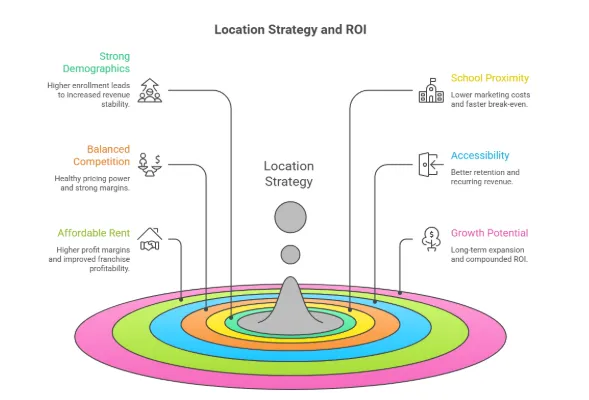
Selecting the best location for an education center is not a matter of instinct; it is a strategic investment decision that directly determines enrollment capacity, operational efficiency, and overall education franchise ROI.
A well-chosen site reduces marketing costs, improves student retention, and accelerates break-even timelines. Here’s a structured, data-driven approach investors can rely on:
1. Analyze Demographics: Identify Revenue-Ready Markets
Demographics form the foundation of a strong franchise location strategy. An education franchise thrives where there is both demand and purchasing power.
| Key Data Points to Study: Number of families with children aged 4–14 Average household income Education, awareness, and academic competitiveness Population growth rate Urban vs. suburban distribution For investors, this translates into predictable enrollment pipelines. Neighborhoods with middle- to upper-income households and strong academic aspirations typically show: Higher willingness to invest in enrichment programs Lower price sensitivity Stronger student retention |
This significantly improves ROI in education business models because revenue stability becomes less volatile.
2. Study School Density: Tap into Existing Academic Ecosystems
Proximity to schools is not a coincidence; it is a strategy.
Mapping the number and reputation of schools within a 3–5 km radius allows investors to estimate the potential student pool.
| Why This Matters: Parents already investing in quality schooling are more likely to enroll their children in enrichment programs.Partnerships with schools create referral channels.After-school accessibility improves convenience and retention rates. |
A location surrounded by reputable schools functions like a built-in marketing engine, reducing acquisition costs and improving education franchise ROI over time.
3. Evaluate the Competitor Landscape: Balance Demand and Saturation
Competition is not always negative. In fact, some level of competition validates demand. However, oversaturation can shrink margins and reduce franchise profitability.
| Conduct Competitor Mapping: Number of tutoring or enrichment centers nearby Their pricing modelsStudent capacity and occupancy levels Brand positioning (premium vs. low-cost)Customer reviews and parent sentiment Investor Insight: Overcrowded competitors may signal unmet demand. Underperforming centers may indicate weak location viability. Absence of competitors could mean either an opportunity or a lack of awareness. |
The goal is to identify a balanced ecosystem, strong demand without excessive supply, which strengthens long-term education franchise ROI.
4. Assess Foot Traffic and Accessibility: Optimize Convenience
In education businesses, convenience drives conversions. Parents prioritize safety, parking, and easy drop-offs over aesthetic appeal.
| Evaluate: Parking availabilityAccess to public transport Visibility from main roadsSafety and lighting Ground-floor vs. upper-floor accessibility An accessible center reduces friction in decision-making. This improves: Enrollment ratesStudent retentionWord-of-mouth referrals |
All of which positively impact ROI in education business operations.
5. Review Rental Costs vs. Revenue Potential: Protect Margins
High rent does not guarantee high returns.
Investors must evaluate whether projected enrollment justifies operational expenses.
| Calculate: Monthly rent and utilities Fit-out and infrastructure costs Expected student capacity Average fee per studentBreak-even timeline |
An overpriced “prime” location may increase brand perception but compress profitability. Sustainable rent-to-revenue ratios are critical for maximizing education franchise ROI.
6. Evaluate Growth Potential: Think Long-Term Scalability
Investors must think beyond immediate returns. A location that supports expansion offers exponential value.
| Look for: New residential developments Upcoming schoolsInfrastructure projects Population migration trends |
Areas under development often offer lower rent today with higher demand tomorrow. Entering early in a growing neighborhood strengthens long-term franchise profitability and brand dominance. Future-ready locations reduce the risk of relocation, which can disrupt enrollment and increase costs.
7. Consult the Franchisor: Leverage Data and Experience
Strong franchise systems provide strategic support in site selection. Leading education brands such as UCMAS often assist franchisees with:
- Territory mapping
- Demographic research
- Market feasibility studies
- Competitive analysis
- Site approval processes
For investors, franchisor-backed location strategy minimizes risk and improves predictability. A collaborative site-selection approach ensures alignment with proven success patterns, strengthening overall franchise location strategy.
KPIs to Measure the ROI of Effective Location Planning
Choosing the right location is only the beginning. Measuring performance ensures your strategy is delivering results. Here are essential KPIs to track:
1. Enrollment Growth Rate
Track monthly and quarterly student enrollment increases. A strong upward trend indicates your location is attracting the right demographic.
2. Customer Acquisition Cost (CAC)
Calculate total marketing spend divided by new enrollments. A well-positioned center should show lower CAC due to organic foot traffic and word-of-mouth referrals.
3. Retention Rate
Measure how many students continue beyond initial enrollment periods. High retention suggests convenience and satisfaction, both influenced by location accessibility.
4. Revenue per Square Foot
Divide total revenue by center size. This KPI reveals how efficiently your physical space generates income and helps evaluate ROI in education business performance.
5. Break-even Timeline
How long did it take to recover your initial investment? A strategic franchise location strategy typically shortens the break-even period, accelerating education franchise ROI.
6. Referral Rate
Track how many new enrollments come through referrals. Strong community-based locations often generate higher referral percentages, enhancing franchise profitability.
7. Occupancy Rate
Monitor classroom utilization. If classrooms are running at 80–90% capacity consistently, your best location for education center planning is likely working effectively.
Common Location Mistakes That Hurt Education Franchise ROI
Understanding what to avoid is equally important:
- Choosing the cheapest rent without analyzing demographics
- Ignoring parking and accessibility
- Overlooking competition saturation
- Failing to consider neighborhood growth trends
- Selecting hidden or low-visibility units
Each of these mistakes can negatively impact education franchise ROI and delay profitability.
Location as a Long-Term Investment – The UCMAS Perspective
In the education industry, success is not accidental; it’s strategic. A strong franchise location strategy is one of the most powerful levers for improving education franchise ROI and long-term franchise profitability.
For brands like UCMAS, location planning plays a critical role in ensuring franchisees operate in high-demand communities with strong growth potential. By combining demographic research, competitor analysis, and community integration strategies, education entrepreneurs can maximize their ROI in education business ventures.
Choosing the best location for an education center’s success is not just about geography; it’s about positioning your franchise at the center of opportunity. Take the first step toward stronger franchise profitability and long-term growth. Secure your spot, explore available territories, and book your consultation now.