



“Who came first?”
It is one of the easiest questions to ask a child after a test, competition, game, or classroom activity. But there is another question that may tell us far more:
“Did you do better than you did last time?”
Children naturally notice what their peers are doing. A little competition can be exciting and even motivating. The problem begins when another child’s score, speed, trophy, or ability becomes the primary yardstick for measuring their own worth.
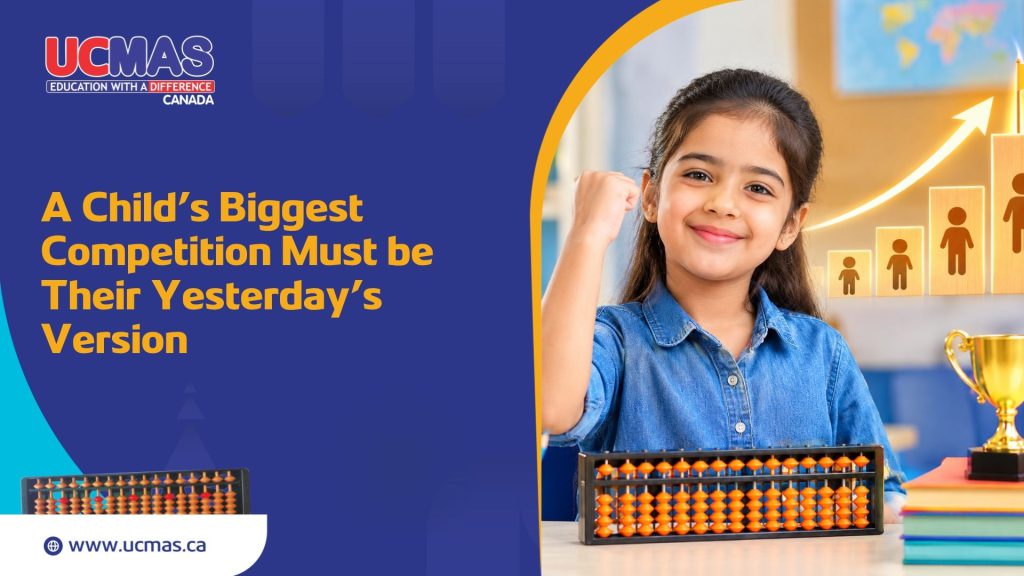
At UCMAS, we believe learning should help children discover what they are capable of becoming. Teaching kids personal progress not comparison means redefining “first” as moving ahead of where they were yesterday.
A child who once needed ten minutes to complete a task and can now do it in eight has progressed. A child who was afraid to answer in class but now raises their hand has progressed. A child who makes fewer calculation errors than last month has progressed.
None of them needs another child to lose for their achievement to matter.
Why Comparison Can Turn Achievement Into Pressure
Understanding why comparison is bad for kids begins with recognising that children develop at different speeds. They have different strengths, interests, temperaments, learning styles, and starting points.
When adults repeatedly say, “Look how well your friend is doing,” or “Your brother never struggled with this,” children may hear something very different from what was intended: Someone else is the standard I have to reach.
Over time, success can become less about learning and more about proving that they are “good enough.”
This can also discourage risk-taking. If a child believes being smart means always performing better than others, difficult tasks become threatening. Why attempt something challenging if struggling might make you look less capable?
That is why a healthier approach is helping children compete with themselves.
Instead of:
“Did you get the highest score?”
Try:
“What can you do today that was difficult for you a month ago?”
That small change puts improvement back at the centre of achievement.
The Only Competition That Never Runs Out
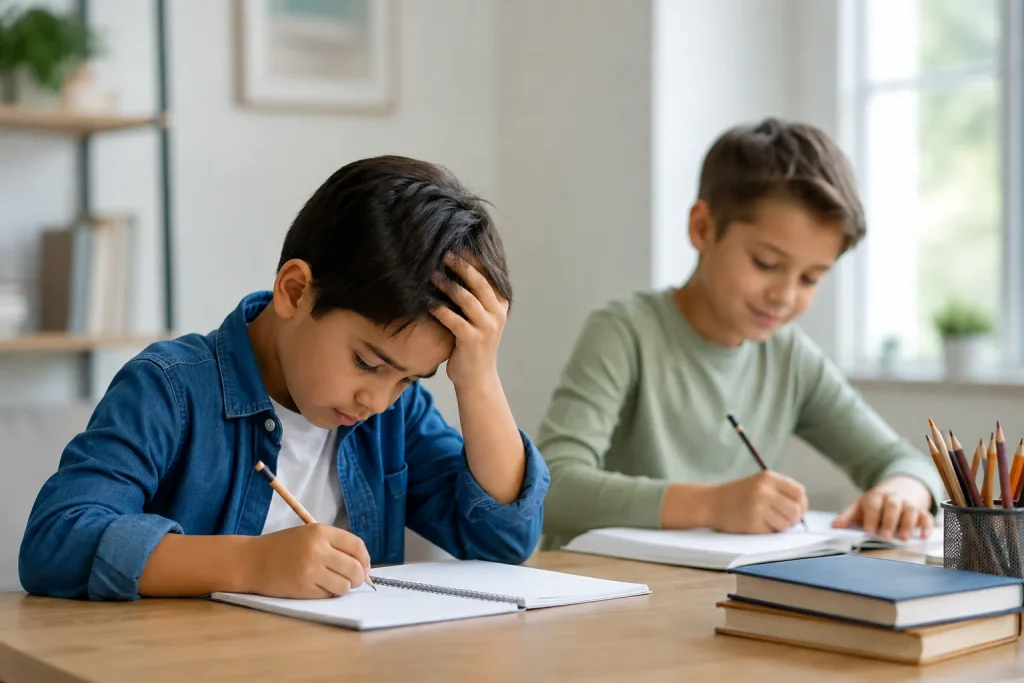
There will always be someone faster, stronger, more experienced, or naturally better at a particular skill. If children depend on outperforming others to feel successful, their confidence can become fragile.
Personal benchmarks work differently.
Can I solve this faster than last week?
Can I concentrate for five minutes longer?
Can I remember more?
Can I correct a mistake without giving up?
Can I attempt a harder problem?
This is self-improvement vs competition for kids in its simplest form. The goal is not to remove ambition. It is to give ambition a healthier direction.
UCMAS programs are designed to develop abilities that extend beyond calculation. Explore how UCMAS builds soft skills in kids to understand how structured learning experiences can support broader personal development.
Growth Mindset Changes What “Winning” Looks Like
A growth mindset for children teaches them that abilities can improve through practice, strategies, patience, feedback, and persistence.
Consider two children who both get seven answers correct out of ten.
One thinks:
“I only got seven. Someone else got ten.”
The other thinks:
“Last time I got five. This time I got seven. What can I change to get eight?”
Same score. Completely different relationship with learning.
The second child sees the result as information rather than a verdict.
That is also why parents and educators should focus on effort not results kids achieve in a single moment. Instead of praising only the final score, notice what created the improvement:
“You kept practising even when it was difficult.”
“You found your mistake and tried again.”
“You concentrated much longer today.”
“You used a new strategy.”
The message becomes clear: progress is something I can influence.
Small Wins Aren’t Small to a Child
Adults often notice milestones. Children live through the tiny steps between them.
Finishing a worksheet independently. Getting one more answer right. Remembering something without prompting. Attempting a question they usually avoid. Staying focused until an activity is complete.
Celebrating small wins children achieve helps them see evidence of their own development.
It does not mean applauding everything or lowering expectations. It means making improvement visible.
This is particularly important when learning a skill that develops progressively. The UCMAS Grade 3 to 6 growth story shows why development is better understood as a journey rather than a single performance.
Building confidence in children through progress works because confidence becomes connected to evidence: I couldn’t do this before. Now I can.
How Mental Math Makes Progress Visible
Mental math offers children something particularly valuable: progress they can experience for themselves.
A child may initially rely heavily on physical calculation methods. With structured practice, processes become more familiar. Accuracy can improve. Calculations that once felt intimidating may become manageable.
Parents unfamiliar with the concept can explore what mental math means for elementary students and how these abilities develop.
The connection between mental math and child confidence is not simply about being able to calculate quickly. It is the experience of watching yourself become more capable through practice.
That experience says:
My effort can change what I am able to do.
This is where an abacus and growth mindset can naturally reinforce one another. Children encounter challenges, practise skills, make mistakes, try again, and gradually recognise their own improvement.
Learn more about the benefits of UCMAS mental math programs for kids.
How to Motivate a Child Without Comparison
If comparison has become part of everyday language at home, changing it does not require eliminating competition altogether. It requires changing what receives the most attention.
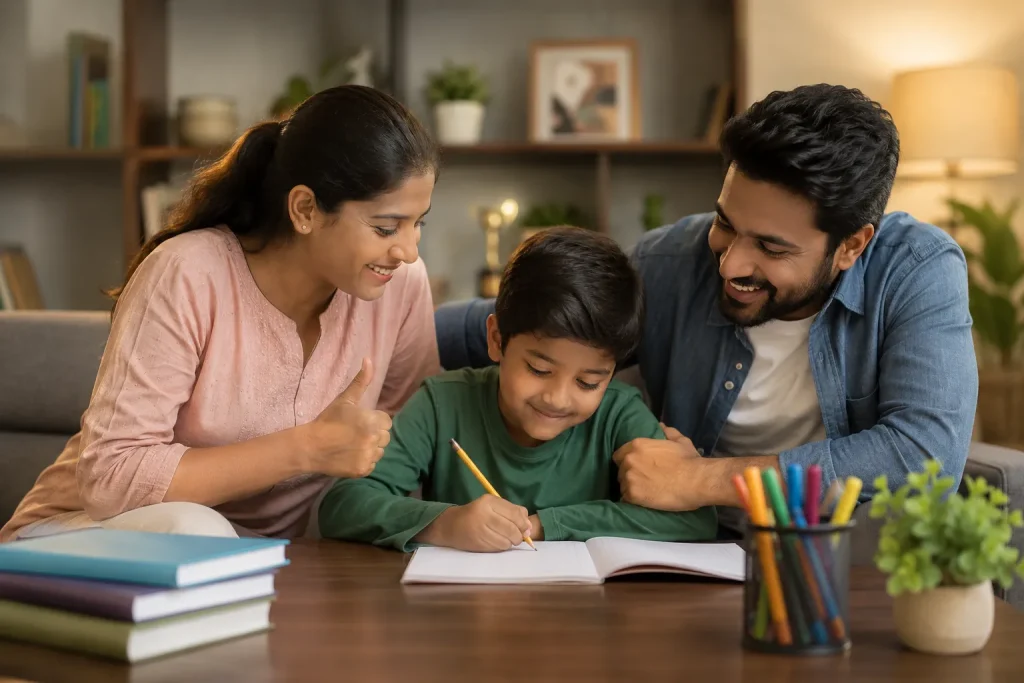
Parents can start by tracking personal milestones. Compare a child’s current work with their previous work rather than someone else’s.
Praise strategies specifically. “You checked your answer twice” is more useful than simply saying, “You’re so smart.”
Ask progress-focused questions. “What became easier this week?” or “What would you like to improve next?” encourages reflection.
Also make room for mistakes. A mistake followed by correction can represent more learning than an easy answer that required little thought.
Most importantly, separate performance from identity. A disappointing result means a child had a disappointing result. It does not mean they are a disappointment.
Competition Isn’t the Enemy
Does this mean children should never compete?
No.
Healthy competition can teach children how to handle excitement, disappointment, goals, rules, teamwork, and pressure. The distinction lies in what happens afterward.
If winning becomes the only proof of ability, competition can become emotionally exhausting. If competition becomes one opportunity to test skills and learn, it can be constructive.
A child can want to win while still recognising someone else’s achievement. They can lose today and still notice that they performed better than before.
That is real progress.
Let “First” Mean Something Bigger
A child does not have to be first in the class to be moving forward.
They can be the first version of themselves to attempt a difficult challenge without quitting.
The first to solve a problem they once thought was impossible.
The first to turn “I can’t” into “I can’t yet.”
When children learn to measure success through growth, effort, and persistence, achievement becomes less dependent on the person sitting next to them.
UCMAS helps children strengthen mental abilities through structured abacus and mental math learning while encouraging them to keep developing their skills.
Because perhaps “being first” was never supposed to mean being ahead of everyone else.
Perhaps it means being ahead of who you were yesterday.
Help your child experience what consistent practice and personal improvement can feel like. Book a UCMAS abacus session and give them an opportunity to build skills one achievement at a time.