




Children today are growing up in a world overflowing with information. A quick search can provide an answer to almost any question, AI can generate ideas in seconds, and digital tools can complete tasks that once required hours of effort.
So, what will help children stand out in this rapidly changing world?
The answer may not be knowing more facts. It may be knowing how to think.
Critical thinking helps children question information, identify patterns, evaluate choices, solve unfamiliar problems, and make decisions instead of simply accepting the first answer they see. Programs such as UCMAS focus on developing these underlying abilities through structured mental development and learning experiences.
What Is Critical Thinking for Children?
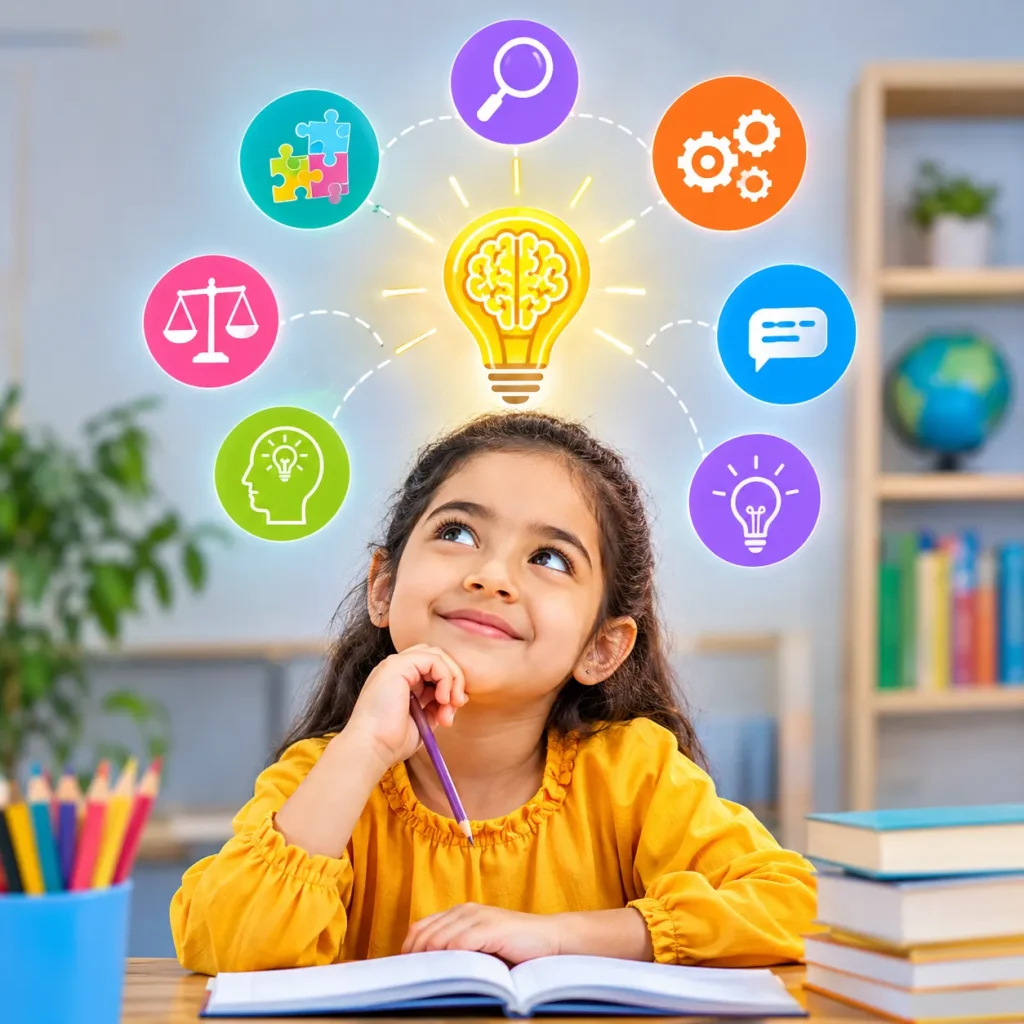
Critical thinking is the ability to look at information carefully, ask questions, make connections, consider different possibilities, and reach a logical conclusion.
For a child, it can appear in surprisingly simple situations.
When a child asks, “Why did this happen?” they are thinking critically. When they try another method after their first solution fails, they are thinking critically. When they compare two choices before deciding which is better, they are using reasoning.
These abilities become increasingly important as children move beyond straightforward classroom exercises and encounter problems where there is not always one obvious path to the answer.
Why Is Critical Thinking Becoming More Valuable?
Here are some reasons that make critical thinking crucial in today’s day and age.
1. Information Is Everywhere
Children no longer depend only on textbooks or teachers for information. They encounter videos, social media, websites, AI tools, advertisements, and online opinions every day.
The challenge is no longer simply finding information. It is deciding whether that information makes sense.
Critical thinking gives children a framework for asking:
- Is this information reliable?
- What evidence supports it?
- Are there other explanations?
- What conclusion can I reasonably make?
These questions can become valuable lifelong habits.
2. Future Problems Won’t Always Have Simple Answers
The jobs and challenges of tomorrow may require children to work with unfamiliar situations. Memorizing a process is useful, but being able to adapt that process to a new problem can be even more valuable.
Developing problem-solving skills for kids can help children become more comfortable breaking complex questions into smaller steps, looking for patterns, testing solutions, and learning from mistakes.
This is one reason parents are increasingly looking beyond traditional academic achievement when thinking about long-term development.
3. Technology Makes Thinking Skills More Important, Not Less
Artificial intelligence can calculate, summarize, generate, and retrieve information quickly. But children still need to decide what questions to ask, whether an answer is reasonable, and how to use information responsibly.
Technology can provide an answer. Critical thinking helps a child evaluate that answer.
This distinction may become even more important as AI becomes a normal part of education, communication, and work.
How Does Mental Math Support Critical Thinking?
Mental math is not simply about calculating numbers quickly. With the right approach, it can encourage children to recognize patterns, remember information, make comparisons, and mentally work through multiple steps.
For example, imagine a child is asked to calculate a problem mentally. Instead of immediately writing down a formula, the child may need to visualize quantities, identify relationships, and decide which strategy is most efficient.
That process involves reasoning.
UCMAS’s mental math program uses structured activities designed to progressively develop mental calculation abilities while engaging concentration, memory, visualization, and analytical thinking.
The goal is not merely to produce faster answers. It is to help children become more comfortable thinking through challenges independently.
From Abacus to Analytical Thinking
The UCMAS abacus math program introduces children to a hands-on learning approach in which the abacus provides a visual and physical representation of numbers.
As children progress, they gradually learn to visualize calculations mentally.
This transition from physically working with numbers to mentally manipulating them can encourage children to hold information in their minds, follow sequences, recognize patterns, and complete multi-step calculations.
That is where abacus mental math can become more than a calculation exercise. It can become a structured opportunity to practise concentration, visualization, sequencing, and logical thinking.
Critical Thinking Also Builds Confidence
There is another important connection: children who learn to approach challenges independently can become more confident in their ability to solve them.
This is where confidence building for kids becomes closely connected to learning.
Imagine a child facing a difficult problem. Instead of immediately saying, “I can’t do this,” the child begins asking, “What can I try first?”
That shift matters.
When children experience small successes, make mistakes, try again, and eventually reach solutions, they learn that difficulty does not necessarily mean failure. It can simply mean that another strategy is needed.
Focus Is the Foundation of Better Thinking
Critical thinking requires attention. A child cannot carefully evaluate information or follow a multi-step thought process while constantly losing track of the task.
Consistent practice can help children strengthen their ability to stay engaged with a problem.
For parents looking for structured learning beyond school hours, UCMAS after-school programs can provide an opportunity for children to practise mental calculation and related cognitive skills within a guided environment.
Similarly, focus classes for children can be valuable when they are designed to make concentration an active part of learning rather than simply asking children to sit still for longer.

Why Structured Learning Matters
Critical thinking does not develop from memorizing a definition of “critical thinking.” Children need opportunities to practise it.
A structured learning environment can gradually increase the difficulty of tasks, allowing children to build skills step by step.
This is particularly useful when children are learning mental math for kids, because activities can move from simpler calculations toward more complex sequences and mental challenges.
Progressive learning can help children experience the connection between effort, strategy, mistakes, and improvement.
That mindset can eventually extend beyond mathematics—to reading, science, school projects, everyday decisions, and future careers.
What Can Parents Do at Home?
Parents do not need to turn every evening into a lesson. Simple questions can encourage better thinking.
Instead of immediately giving a child an answer, try asking:
- “What makes you think that?”
- “Can you think of another way?”
- “What would happen if we changed this?”
- “How did you reach that answer?”
- “What could you try if your first idea doesn’t work?”
These questions encourage children to explain their reasoning rather than simply produce an answer.
Parents can also encourage children to treat mistakes as part of learning. When a child gets something wrong, discussing the thinking process can be more valuable than simply correcting the final answer.
The Real Advantage Is Learning How to Think
The world children will enter as adults will continue to change. New technologies, new careers, and new challenges will emerge faster than many of us can predict.
That makes it difficult to prepare children for every specific problem they may encounter.
But we can help them develop the ability to approach unfamiliar problems with curiosity, focus, reasoning, and confidence.
That is why critical thinking is becoming more valuable than ever.
For parents exploring structured programs that support these critical thinking abilities, UCMAS Canada offers learning opportunities designed around children’s cognitive development and mental math skills.
Book an abacus session with UCMAS and discover how learning to calculate can also become an opportunity to learn how to think.