

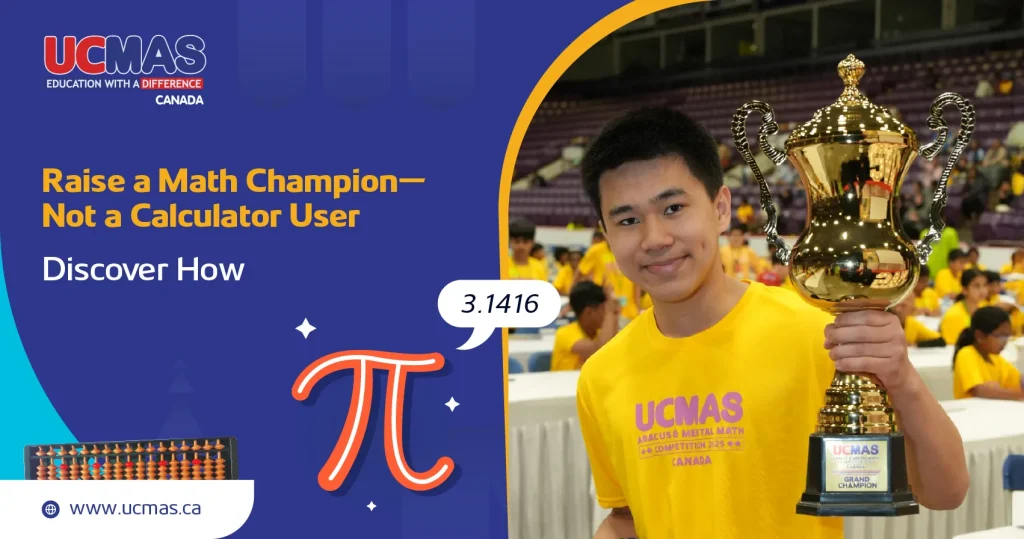

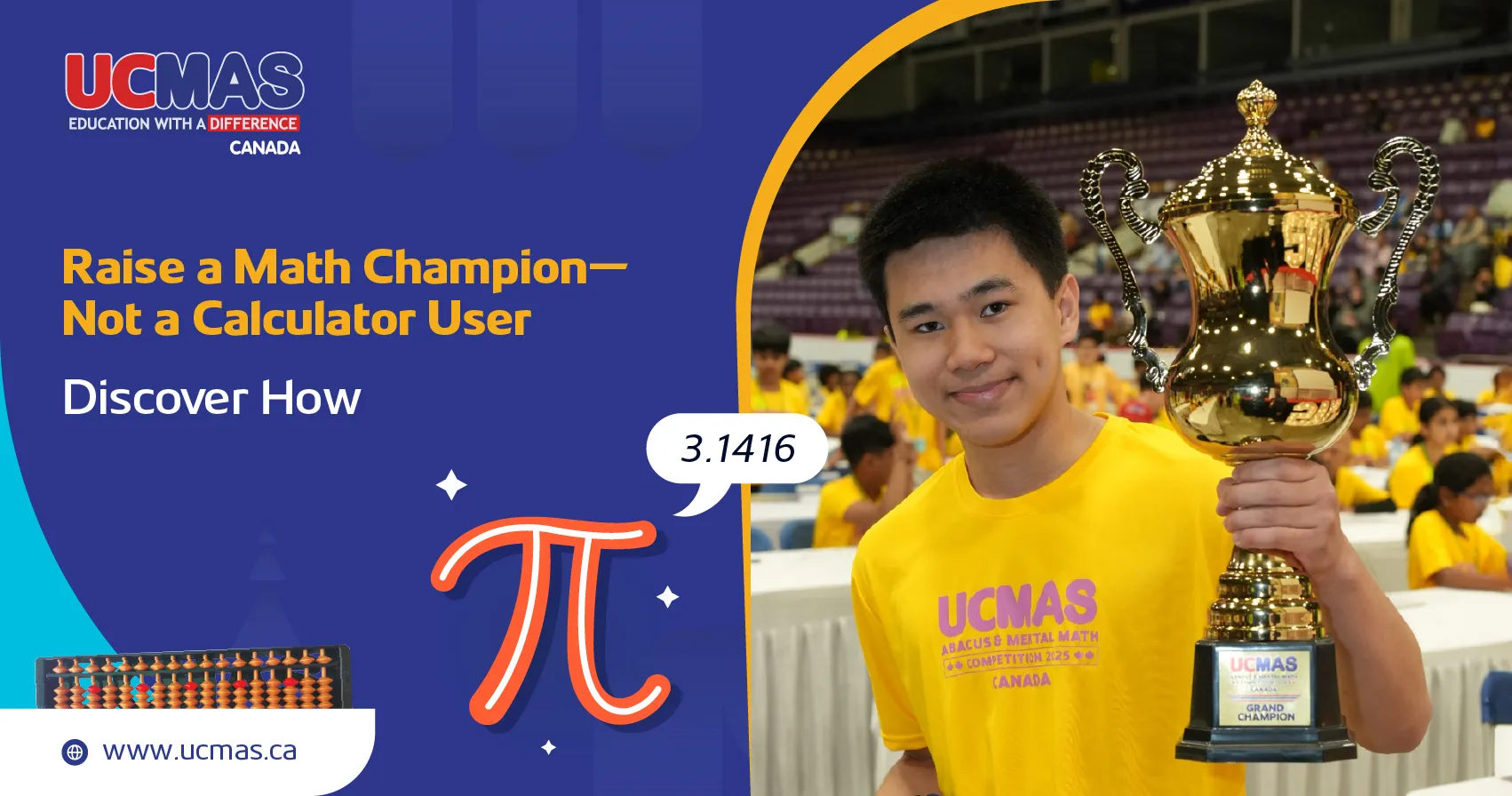
Every year on March 14, classrooms across Canada transform into hubs of circular geometry and pun-filled snack breaks. We celebrate Pi Day—that magical 3.14—honoring the most famous ratio in the universe. But for a UCMAS parent, Pi Day is more than just a reason to eat dessert. It’s a wake-up call.
While students across the country are competing to see who can memorize the most digits of pi, a deeper question lingers: Is your child truly mastering the language of numbers, or are they just becoming reliant on a piece of plastic in their backpack? In an era of instant gratification, true math mastery isn’t found in a Google search; it’s built through mental math training for kids.
The secret to lifelong success isn’t just knowing that pi represents the ratio of a circle’s circumference to its diameter. It’s about having the cognitive math skills to process that information with lightning speed.
In this article, we’ll dive into why speed and accuracy are the twin pillars of genius, and how you can help your child move from calculator-dependent to a mental math marvel.
Why Calculation Speed Matters in a Child’s Mathematical Development
Speed in mathematics is often misunderstood as “rushing.” In reality, when a child calculates quickly, it is a biological signal that their brain has moved past manual labor and into high-level processing. Speed is the byproduct of a well-oiled cognitive machine.
Speed Builds Stronger Number Sense
When a child utilizes fast calculation techniques, they stop seeing numbers as scary obstacles and start seeing them as friends. Quick calculation strengthens number familiarity, allowing children to recognize patterns instantly rather than laboring over individual steps.
Faster Thinking Improves Academic Performance
We’ve all seen it: a child understands a complex word problem, but they run out of time on the test because they spent ten minutes on basic multiplication. By working to improve calculation speed, students free up “mental bandwidth.” When the arithmetic becomes automatic, the brain can focus entirely on the complex reasoning required for high-level Canadian curriculum standards.
Speed Enhances Cognitive Processing
The brain is a muscle. Engaging in high-speed mental arithmetic activates regions responsible for working memory and logic. This regular “sprint” for the brain leads to overall better brain development math outcomes, making the child sharper not just in math, but in language and science too.
How Mental Math Training Improves Accuracy
Speed is thrilling, but speed without precision is just a fast way to get the wrong answer. Math accuracy training ensures that as a child’s “mental engine” gets faster, their “steering” becomes more precise.
Mental Visualization Strengthens Precision
Accuracy is the foundation of confidence. In mental math training for kids, students are taught to visualize numbers as physical objects. This mental imagery acts as a safeguard against common errors. When a child can “see” the calculation in their mind’s eye, they are far less likely to make the “silly mistakes” that usually plague homework sessions.
Structured Practice Reduces Mistakes
There is no shortcut to perfection. Regular drills build a sense of calculation discipline. Through the UCMAS methodology, repetition improves pattern recognition, helping students develop internal “checking habits.” They begin to sense when an answer “feels” wrong before they even finish the problem.
Accuracy Builds Mathematical Confidence
Nothing kills a child’s love for math faster than a page full of red “X” marks. Conversely, consistent correct answers reinforce motivation. When a child masters math accuracy training, they become fearless. They stop saying “I’m not a math person” and start asking for harder challenges.
Abacus vs. Calculator Dependency: Why Mental Calculation Still Matters
Calculators are convenient, but they are “cognitive crutches.” If a child uses a calculator before they understand the mechanics of the number, they are essentially outsourcing their thinking to a battery-powered box.
Calculator Dependency Weakens Number Skills
When students skip foundational calculations, they miss out on the “weight” of numbers. Research shows that early calculator dependency leads to a lack of engagement with number relationships and reduced mental exercise. If the brain doesn’t have to do the work, it won’t grow the neural pathways necessary for cognitive math skills.
Abacus Training Activates the Whole Brain
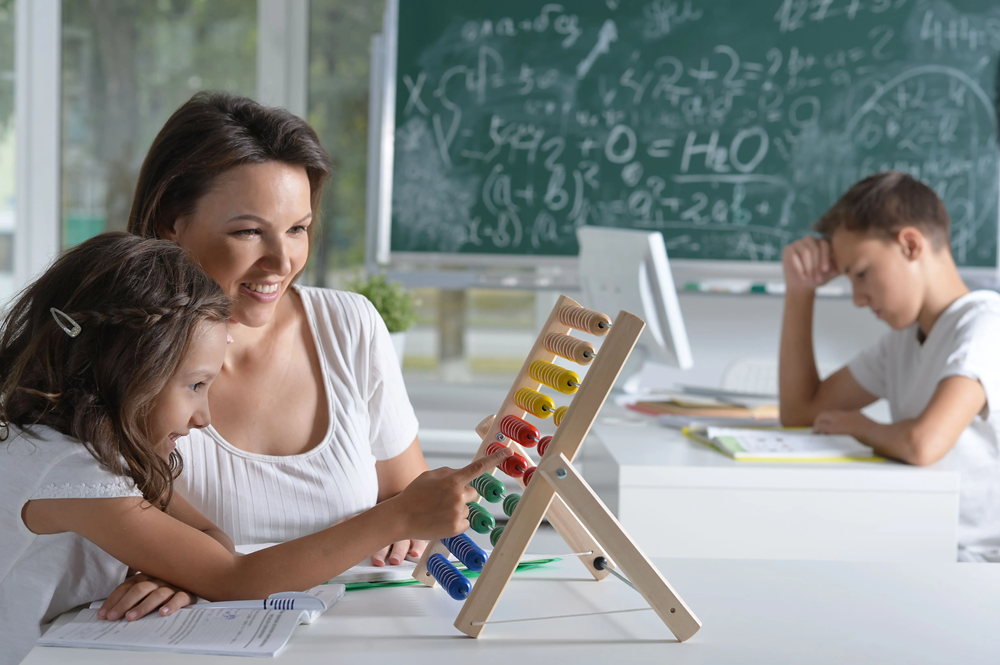
Unlike a calculator, which requires only a finger tap, abacus training involves visual, auditory, and motor skills simultaneously. This “multisensory” approach is a powerhouse for brain development math. By visualizing the beads moving, children activate both the logical left brain and the creative right brain, creating a holistic intellectual edge.
Mental Math Encourages Active Learning
Mental calculation turns a student from a passive observer into an active participant. It encourages curiosity and numerical intuition. A child who can calculate 15 times 12 in their head understands the “why” behind the numbers, whereas a child using a calculator only understands the “how” of the buttons.
How UCMAS Trains Speed, Accuracy, and Concentration
UCMAS isn’t just a tutoring center; it’s a mental gymnasium. As one of the world’s leading programs, it uses the ancient power of the abacus to unlock modern mental potential.
Abacus-Based Learning Method
The journey begins with the physical abacus. Children learn to manipulate beads to represent values. Slowly, the physical tool is removed, and the child learns to manipulate a “virtual abacus” in their mind. This transition is the ultimate form of mental math training for kids, providing a permanent mental toolkit they carry for life.
Structured Multi-Level Training
UCMAS utilizes progressive levels that introduce increasingly complex calculations. By using fast calculation techniques in a timed environment, children learn to perform under pressure. These drills are specifically designed to improve calculation speed while maintaining 100% precision.
Focus and Memory Development
Mental arithmetic requires intense, unwavering concentration. You cannot calculate 843 + 219 – 456 mentally if your mind is wandering. This training naturally spills over into other subjects, helping Canadian students perform better in reading comprehension and focus during long school days.
Real Classroom Outcomes: What Parents Often Notice
The most rewarding part of UCMAS training isn’t the trophies—it’s the transformation parents see at the kitchen table during homework time.
Improved Focus in School: Parents of UCMAS students frequently report that their children can concentrate for longer periods. The “brain fog” that often accompanies math homework disappears, replaced by a disciplined approach to tasks.
Greater Confidence With Numbers: When a child can beat their parents at a math challenge, their self-esteem skyrockets. This confidence isn’t just about math; it’s about the realization that they can master a difficult skill through effort.
Stronger Academic Performance: The results speak for themselves: better grades, faster exam completion, and improved logical thinking. Many UCMAS parents find that their children, once intimidated by numbers, are now seeking out Pi Day challenges just for fun!
Celebrating Pi Day by Building Lifelong Math Skills
Pi Day is a fantastic “entry point,” but don’t let the celebration end when the last slice of pie is gone. Use this day to ignite a lifelong passion for numerical mastery.
Pi Challenges That Build Mental Strength
Turn Pi Day into a family competition! Try memorizing digits of pi, or engage in speed math competitions. These activities make brain development math feel like a game, which is the most effective way for children to learn.
Turning Pi Day Into a Learning Opportunity
Encourage puzzles, logic games, and mental math drills. If your child is fascinated by the infinite nature of pi, show them that their own mental potential is just as limitless. Introduce them to fast calculation techniques that make them feel like superheroes.
From Pi Day Curiosity to Lifelong Math Confidence
Mathematical ability isn’t a “gift” some children are born with; it is a skill grown through practice, speed training, and math accuracy training. By moving beyond the calculator and embracing the power of the mind, you are giving your child a head start that will last a lifetime.
Mental math strengthens the very core of a child’s intellect—their focus, their memory, and their problem-solving ability. This Pi Day, let’s celebrate the beauty of pi, but let’s also commit to the cognitive math skills that turn students into champions. Join the thousands of Canadian families at UCMAS who are proving that the human brain is the most powerful computer on earth.
Ready to see your child think faster and calculate smarter? Click here to Book a Free Abacus Session Today!